AI Can Give You a Protocol. It Cannot Give You Care.
Aug 18, 2026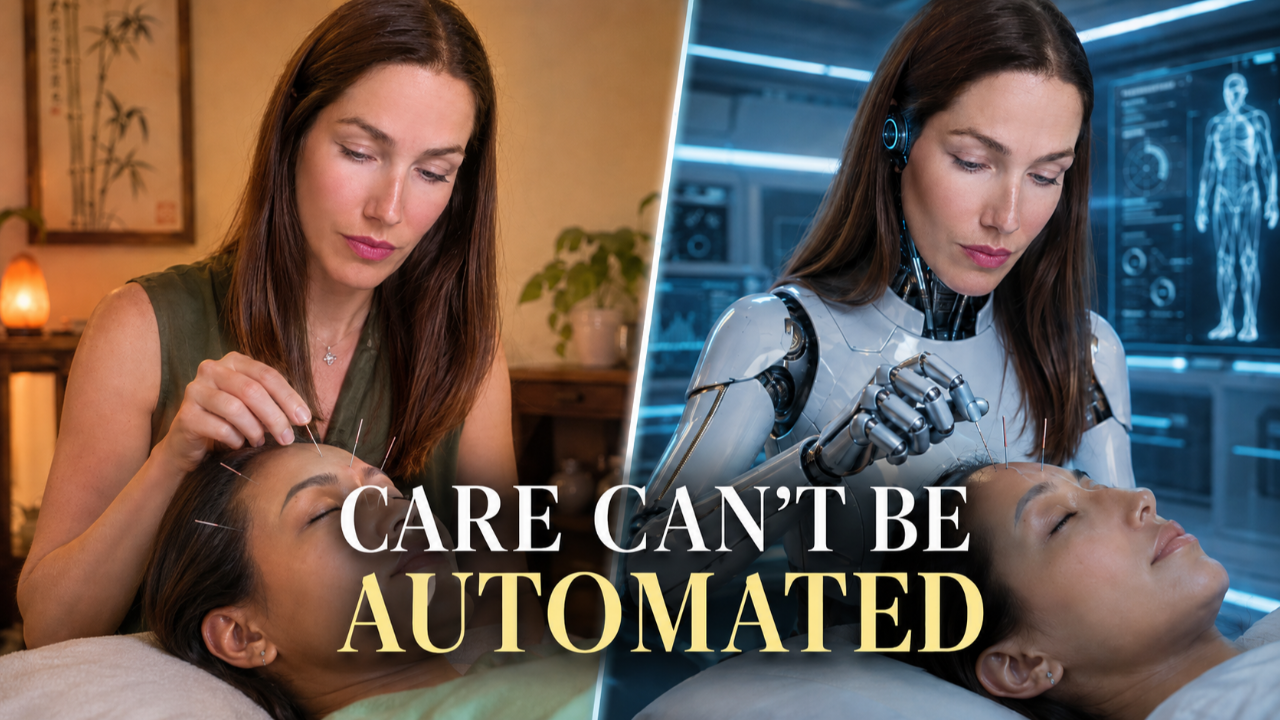
A lot of people are afraid AI is going to take their jobs.
And honestly, I understand the fear. It is not irrational. Technology has already changed the way people work, communicate, create, research, write, market, learn, and make decisions. AI can summarize information, draft emails, analyze patterns, generate content, answer questions, organize data, and produce a disturbingly confident paragraph about almost anything in less time than it takes most people to find their reading glasses.
So yes, some jobs will change. Some tasks will be automated. Some industries will have to adapt. Pretending otherwise feels naive.
But there are parts of human work that AI cannot replace because the work was never just the task.
Healthcare is one of those places. Especially the kind of healthcare that involves human touch, presence, nuance, intuition, trust, and care.
I think about this every time someone talks about machines replacing bodywork. Because let’s be honest: if a machine could give a truly good massage, massage therapists would already be obsolete. We have had massage chairs, massage guns, vibrating mats, compression boots, heated rollers, percussive devices, and every possible version of “massage this” and “massage that” for years now. Some of them are useful. I am not against tools. A massage gun can be great for certain situations. A heated chair can feel wonderful. Technology can support the body.
But it is not the same thing as being worked on by a skilled human being.
It's just not.
A machine can press. It can vibrate. It can roll. It can pulse. It can deliver pressure in a predictable pattern. But it cannot feel the moment your tissue changes. It cannot notice the way your breath shifts when your nervous system starts to let go. It cannot sense hesitation, guarding, fear, tenderness, grief, or the difference between “that hurts in a useful way” and “my body does not feel safe here.” It cannot adjust based on the subtle conversation happening between two human nervous systems in the room.
That is not mystical. That is human.
The same is true with acupuncture. Could AI suggest an acupuncture protocol? Absolutely. It can list points. It can summarize patterns. It can generate treatment ideas based on symptoms. It can probably produce a very impressive-looking plan for low back pain, insomnia, headaches, digestion, stress, or whatever else someone types into a box.
But acupuncture is not just a protocol.
A treatment is not simply, “Insert point A, add point B, wait twenty minutes, congratulations, healing has occurred.”
If that were true, every practitioner would get the same result every time, and every patient would respond in the same way. But bodies are not that simple. People are not that simple. Healing is not that mechanical.
A real treatment involves observation. Tone of voice. Skin color. Posture. Tension. Breath. Timing. The way someone describes pain. The way they avoid describing pain. The way they laugh something off even though their body says it matters. The difference between a person who needs stimulation and a person who needs less. The difference between a body that is ready to release and a body that will guard harder if you push too fast.
There is nuance.
There is intuition.
There is relationship.
There is a feeling in the room.
There is the quiet intelligence of one human paying close attention to another.
That is the part AI cannot replicate.
And I think this matters because modern healthcare already has a tendency to reduce people into data. Labs, scans, numbers, symptoms, codes, scores, metrics, protocols, algorithms. All of those things can be helpful. Information matters. Diagnosis matters. Technology matters. I am not interested in throwing out modern tools and pretending the answer to everything is candlelight and vibes. That is not healthcare either.
But when healthcare becomes only data, something essential gets lost.
The person gets lost.
The body gets treated like a machine. The symptom gets separated from the life. The protocol becomes more important than the human being receiving it. The chart becomes cleaner while the patient feels less seen.
And this is exactly why human care still matters.
Because sometimes what helps a person heal is not only what is done to them. It is how they are met.
A person can feel when you are present. They can feel when your hands are listening. They can feel when you are not rushing. They can feel when you are not treating them like a diagnosis, a transaction, or a body on a table. They can feel when you are paying attention to the whole of them, not just the part that hurts.
That feeling matters.
It matters in massage. It matters in acupuncture. It matters in facials. It matters in nursing. It matters in bedside care. It matters in therapy. It matters in any kind of healing work where the human nervous system is involved, which is to say, all of it.
Because people do not only need information.
They need to feel safe enough to receive care.
They need to feel seen enough to tell the truth.
They need to feel trusted enough to trust their own body again.
And yes, AI can help us. I use AI as a tool. I think it can be incredibly useful for education, writing, brainstorming, organizing ideas, summarizing research, and helping people understand complicated topics. I do not think the answer is to fear every new technology and retreat into a bunker made of handwritten SOAP notes and moral superiority.
But a tool is not the same as a healer.
A tool can support care. It cannot become care.
This is the distinction we need to protect.
Because the more advanced technology becomes, the more valuable genuine human presence may become. Not less. More.
When everything is automated, real attention becomes rare. When everything is optimized, patience becomes rare. When everything is measured, intuition becomes rare. When everything is fast, slowness becomes medicine. When every answer can be generated instantly, the experience of being deeply listened to by another human being becomes even more precious.
That is why I am not afraid of AI replacing the heart of what I do.
It may change the way I work. It may change how people find information. It may change how practitioners educate, document, market, and organize their thoughts. Fine. We can adapt. We should adapt.
But AI cannot replace the moment when a patient walks into the room carrying pain they have been explaining for years, and someone finally looks at them with enough presence to say, “I believe your body is telling us something.”
AI cannot replace the feel of a skilled hand noticing where the body is guarding.
It cannot replace the trust that builds when someone feels safe enough to exhale.
It cannot replace the care that lives in the space between technique and presence.
It cannot replace the subtle intelligence of human-to-human healing.
And maybe that is the deeper point.
The future of healthcare should not be humans versus machines.
It should be humans using tools without forgetting what makes care human.
Because if we let technology replace the parts of healthcare that are mechanical, repetitive, administrative, and informational, perhaps that gives us an opportunity to become even better at the parts technology cannot do.
Presence. Touch. Listening. Discernment. Relationship. Compassion. Nuance. Trust.
The things that do not scale easily.
The things that do not fit neatly into an algorithm.
The things that make a person feel less like a problem to be solved and more like a human being worthy of care.
That is not obsolete.
That is the work.
And if anything, I think we are going to need more of it.
Keep moving, eat something green, and question anything that sounds like a quick fix.
Chow! Chow!