Front Porch vs. Back Porch
Jul 07, 2026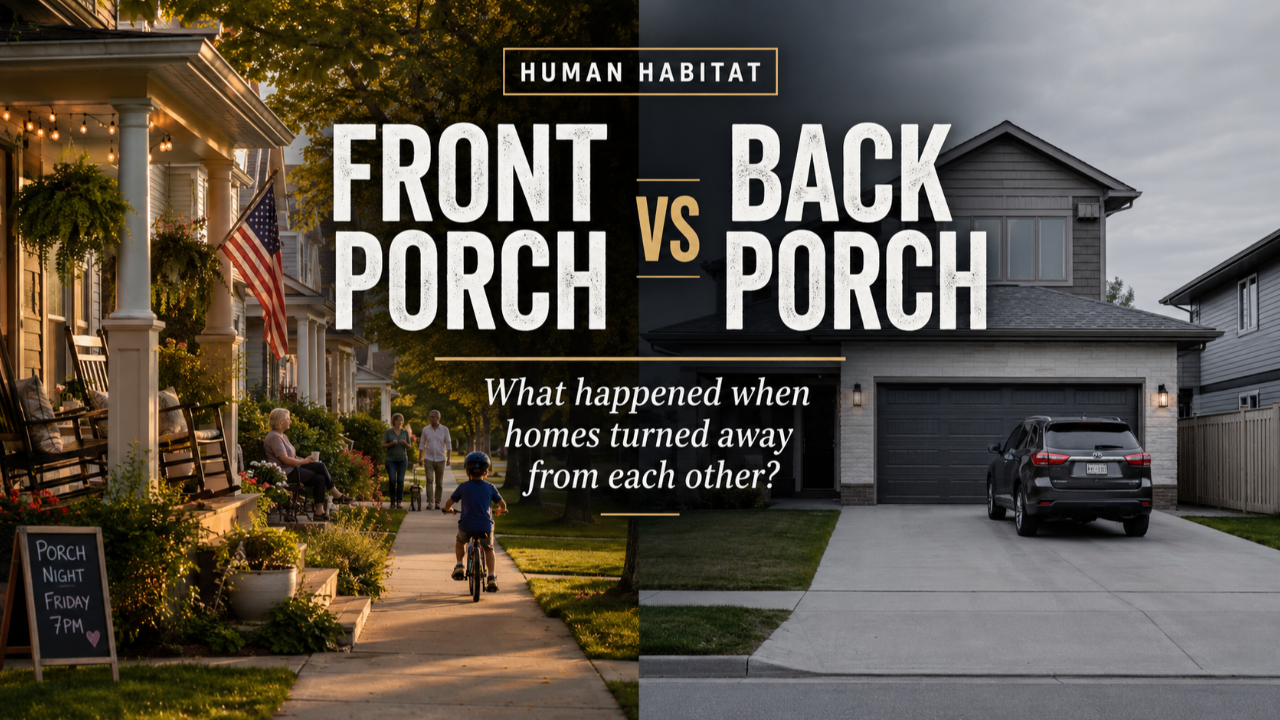
What Happened When Our Homes Turned Away From Each Other?
On my morning walk, I started thinking about the difference between a front porch and a back porch.
A back porch says: come away from the world. Rest. Retreat. Be private. Exhale where no one is watching.
And honestly, we need that.
I am not here to start an anti-back-porch movement. Please do not panic and throw your patio furniture into the street. Privacy matters. Retreat matters. Silence matters. Sometimes the healthiest thing a human can do is disappear for a little while, drink tea, stare at a tree, and not be perceived by another living soul.
But a front porch says something different.
A front porch says: I am still part of the world. I am home, but I am not hidden.
I can wave to my neighbor. I can watch children ride bikes down the street. I can notice who is walking their dog, who looks tired, who might need help, who I have not seen in a while.
A front porch creates a soft edge between private life and public life.
Not everything has to be an event.
Not every connection has to be scheduled.
Not every relationship has to begin with a text message, a calendar invite, or a perfectly planned dinner where everyone has to compare allergies, parking situations, and whether or not anyone is “free next Thursday.”
Sometimes community begins because two people are simply visible to each other.
And somewhere along the way, that visibility started disappearing from the way we build homes.
When the House Turned Away From the Street
The front porch did not disappear overnight.
There was not one dramatic architectural villain standing in a cul-de-sac saying, “No more porches! From now on, everyone shall enter through the garage and wave to no one!”
Although, honestly, that would make a great Pixar villain.
The shift happened slowly.
Older neighborhoods were often built with homes facing the street. Porches, stoops, sidewalks, windows, gardens, and front steps created a relationship between the house and the public world. The home had a face. The street had a rhythm. People passed each other naturally.
Then, over the twentieth century, several things changed.
Cars became central to American life. Streets became faster and less pleasant to sit beside. Suburban development expanded. Houses became more oriented around privacy and convenience. Air conditioning made the porch less necessary for cooling the house. Television moved evening life indoors. Backyards and patios became the preferred outdoor retreat. Attached garages became more common, and eventually, in many neighborhoods, the garage became the most prominent feature on the front of the house. Reference
Michigan State University Extension has a wonderful, direct way of describing this shift. It notes that the front porch was once an anchor of neighborhood social life and helped create social capital. But over time, garages replaced front porches as the primary design element of many homes. Reference
That is a small architectural sentence with a massive cultural meaning.
The front of the house used to say:
People live here.
Now, in many neighborhoods, the front of the house says:
Cars live here, and the humans will be inside shortly after parking.
I say this with love as someone who understands the glory of bringing groceries inside directly from the garage during bad weather. Convenience is seductive. I get it. Nobody wants to carry five bags of groceries, a watermelon, and their dignity through a snowstorm.
But convenience always asks for payment somewhere.
And sometimes the payment is connection.
When the garage becomes the main entrance, the daily ritual changes. You drive home. You press a button. A large door opens. You pull in. The door closes. You enter your private world without ever stepping into the neighborhood.
No porch.
No sidewalk pause.
No wave.
No casual conversation.
No “I have not seen Mrs. Thompson in a few days; I wonder if she is okay.”
Just arrival, enclosure, disappearance.
The house turns away from the street.
And when our homes turned away from the street, many of us slowly turned away from each other.
The Back Porch Is Not the Problem
To be clear, the back porch is not the villain.
The back porch gives us retreat. It gives us privacy. It gives us a place to take off the social mask, breathe, garden, rest, grill vegetables, ignore emails, or sit in silence pretending we are not listening to the neighbor’s entire phone conversation. Reference
The problem is not that we created private space.
The problem is that, in many communities, private space became almost the only space.
Fenced backyards. Closed garages. Long commutes. Private screens. Individual routines. Neighborhoods without sidewalks. Streets too fast for children to play near. Stores too far to walk to. Parks that require driving. Community that must be scheduled, coordinated, and squeezed between work, errands, exhaustion, and whatever new show everyone is pretending they are not binge-watching.
We did not simply lose the front porch.
We lost an entire layer of low-pressure human contact.
And that matters.
Because casual contact is not meaningless. It is not a cute bonus. It is not just something old people romanticize while telling you, “Back in my day, we knew our neighbors,” right before handing you a suspicious casserole.
Casual contact is part of how people feel socially held.
It is how neighborhoods become more than a collection of private houses.
It is how children grow up being seen by adults beyond their immediate family.
It is how people notice when someone is struggling.
It is how loneliness is interrupted before it becomes an identity.
It is how belonging happens without needing to be announced.
The Architecture of Belonging
This is part of what I mean when I say:
Healthy humans need healthy habitats.
Our health is not only shaped by what we eat, how we move, or what treatments we receive. It is also shaped by whether our environment invites us into connection, rhythm, beauty, movement, and belonging.
It is not nostalgia.
It is not just “old houses were prettier.”
Although, let’s be honest, some of them absolutely were.
It is a question of whether our environments support the kind of nervous systems, relationships, and communities we say we want.
Do our neighborhoods invite us to walk?
Do our homes give us places to be visible without being exposed?
Do our streets allow children to move safely?
Do our communities offer places to gather without needing to buy something expensive, make a reservation, or justify our presence?
Do we have spaces where we can belong without performing?
A front porch is architecturally small, but psychologically powerful.
It is a threshold.
It is neither fully private nor fully public. It lets you be at home while still participating in the world. It allows connection without commitment. It gives the nervous system a place to practice gentle visibility.
That may sound simple, but in an age where many people feel either overexposed online or isolated in real life, gentle visibility is no small thing.
We have built a world with more digital visibility than ever and less embodied visibility than we may know what to do with.
People can see your vacation photos, your dinner, your opinions, your workout, your professional update, your haircut, your dog, your latte, your breakdown disguised as a meme.
But do your neighbors see you?
Do you see them?
Do you know the faces in the habitat you live in?
Do you feel connected to the world immediately around you, or do you mostly interact with people through devices, appointments, transactions, and traffic?
We Vacation in Places Designed for Humans
Here is the part I cannot stop thinking about:
We vacation in places designed for humans, then return to places designed for cars, privacy, and productivity.
Think about the places people love to visit.
Old towns. Lake towns. Beach towns. Walkable villages. European city centers. Main streets with cafés. Farmers markets. Boardwalks. Front porches. Courtyards. Public benches. Parks. Plazas. Trails. Little shops you can wander into. Restaurants with outdoor seating. Streets where you can walk without feeling like you are trespassing on infrastructure designed exclusively for vehicles.
People love these places.
We travel to them, take photos of them, pay extra to stay in them, then describe them with words like charming, relaxing, beautiful, peaceful, alive, and magical.
But are they magical?
Or are they simply designed around human needs we have been trained to treat as vacation luxuries?
Beauty.
Walkability.
Public life.
Water.
Trees.
Porches.
Sidewalks.
Gathering spaces.
Local shops.
Unhurried meals.
Casual conversation.
A sense of place.
We treat human-centered design like a luxury experience instead of a public health necessity.
Then we wonder why people are lonely, overstimulated, under-inspired, exhausted, and desperate to “get away.”
Get away from what?
Their own lives?
Their own neighborhoods?
Their own schedules?
Their own built environment?
Where do you live versus where do you prefer to visit?
What does your vacation self have access to that your everyday self does not?
Do you come alive in places where you can walk to coffee, sit near water, hear live music, browse a market, linger outdoors, and encounter people without needing to plan every interaction?
And if so, what does that tell you?
The Seaside Question
There is a reason places like Seaside, Florida became famous.
Harvard’s Urban Design Case Study Archive describes Seaside as a compact, walkable community organized around a mixed-use town square, with narrow streets, pedestrian paths, and design choices meant to support walkability and neighborly interaction. Reference
In other words, Seaside did not become appealing by accident.
It was designed to feel human.
Now, Seaside has its own complexities. It is not perfect. It is expensive. It has become, in many ways, exactly what often happens when human-centered design is treated as rare: it becomes desirable, scarce, and priced like a luxury.
But the lesson remains.
People are drawn to places where the environment invites them to be more human.
We like places where we can walk.
We like places where architecture has beauty and character.
We like places where public space feels alive.
We like places where porches, paths, shops, water, trees, and gathering spaces create a sense that life is happening around us, not hidden behind garage doors and privacy fences.
So why do we keep building the opposite?
Why are human-centered environments often reserved for vacations, historic districts, resort towns, or places only the wealthy can afford?
Why do so many people spend their everyday lives in places that make health harder, then spend their limited time off trying to recover in places that make being human feel natural again?
That question should bother us.
Not in a hopeless way.
In a wake-up way.
The Nervous System Knows
Your nervous system is always reading the environment.
It reads light, sound, space, texture, distance, safety, beauty, movement, and social cues.
It knows the difference between walking down a shaded street with porches, trees, benches, and people nearby, and walking along a six-lane road beside speeding cars and big-box parking lots.
It knows the difference between sitting in a public square where people linger and sitting in a strip mall parking lot wondering why your soul feels like a receipt from a gas station.
It knows the difference between being privately comfortable and socially held.
This does not mean everyone needs to live in a tiny village and know every neighbor’s sourdough starter by name.
It means our environments matter.
And if we are serious about health, we have to stop pretending the body exists in isolation.
A body lives somewhere.
It wakes up somewhere.
It drives, bikes, or walks somewhere.
It eats somewhere.
It rests somewhere.
It belongs, or does not belong, somewhere.
Healing is not only about what you eat, take, or treat. It is also about the life you build, the rhythms you keep, and the environment that holds you.
The Loss of Casual Belonging
One of the great losses of modern life is that so much connection now requires intention.
You have to text.
Schedule.
Coordinate.
Plan.
Host.
Drive.
Buy something.
Sign up.
Log in.
Create an account.
Download the app.
Remember the password.
Reset the password.
Question your entire existence.
This is not how humans were meant to experience every layer of social life.
We need intentional relationships, yes. But we also need ambient belonging. The background sense that we are part of a place. The front porch once helped create that. So did sidewalks. Corner stores. Libraries. Parks. Playgrounds. Markets. Town squares. Churches. Cafés. Barber shops. Community centers. Schoolyards. Neighborhood gardens.
Third spaces.
Threshold spaces.
Places where life overlaps.
When those disappear, our lives become more efficient but less woven together. The irony is that many people have never been more reachable and never felt less known. We can be contacted at any moment, but that is not the same as being held by a community.
A notification is not a neighbor. A group chat is not a sidewalk. A social media feed is not a front porch.
Useful? Sometimes.
Enough? I do not think so.
The Dialectic: Privacy and Visibility
This is where the dialectic matters.
We need privacy. And we need visibility.
We need retreat. And we need belonging.
We need homes that protect us. And we need homes that do not completely remove us from the world.
A healthy habitat does not force constant interaction. Nobody wants to be trapped in a neighborhood where every trip to the mailbox becomes a forty-five-minute conversation about mulch.
But a healthy habitat does create possibilities.
It gives people soft ways to connect.
A place to sit.
A place to wave.
A place to walk.
A place to pause.
A place to be seen without being consumed.
The front porch matters because it gives us an architecture of choice. You can sit outside with your coffee and be available to the world without hosting the world. You can witness the neighborhood without leaving home. You can belong without performing. And that is a form of health.
What Are We Building?
So maybe the question is not simply, “Should homes have front porches again?”
Maybe the question is:
What kind of humans are our homes helping us become?
What kind of nervous systems are our neighborhoods producing?
What kind of relationships are our streets making easy or difficult?
What kind of childhoods are we designing?
What kind of aging are we supporting?
What kind of freedom are we actually building?
Because health is not only about bodies that function. It is about lives that have room for rhythm, beauty, visibility, privacy, connection, and belonging.
Healthy humans need healthy habitats — not only bodies that function, but lives designed for rhythm, beauty, visibility, privacy, connection, and belonging. The front porch disappeared when the home turned away from the street. And when our homes turned away from the street, many of us slowly turned away from each other.
But the story does not have to end there. We can begin noticing again. We can choose homes, neighborhoods, routines, and gathering places with more care. We can sit outside. We can walk the same paths often enough to become familiar. We can support local cafés, libraries, markets, gardens, parks, and public spaces. We can build front-porch energy even when we do not have an actual front porch. We can ask better questions of developers, city planners, neighborhoods, and ourselves.
Where am I gently visible?
Where do I belong without performing?
Where can connection happen without needing to be scheduled?
Where does my body feel more human?
Where do I live?
Where do I prefer to visit?
And what does that difference reveal?
Because maybe the places we long to escape to are not just vacations. Maybe they are clues. Maybe they are showing us something our bodies already know. Health is not only personal. It is architectural. It is social. It is environmental. It is cultural.
And if we want healthy humans, we have to start building habitats that make being healthy, connected, and alive feel natural again.