When Did Looking Healthy Replace Being Healthy?
Jun 16, 2026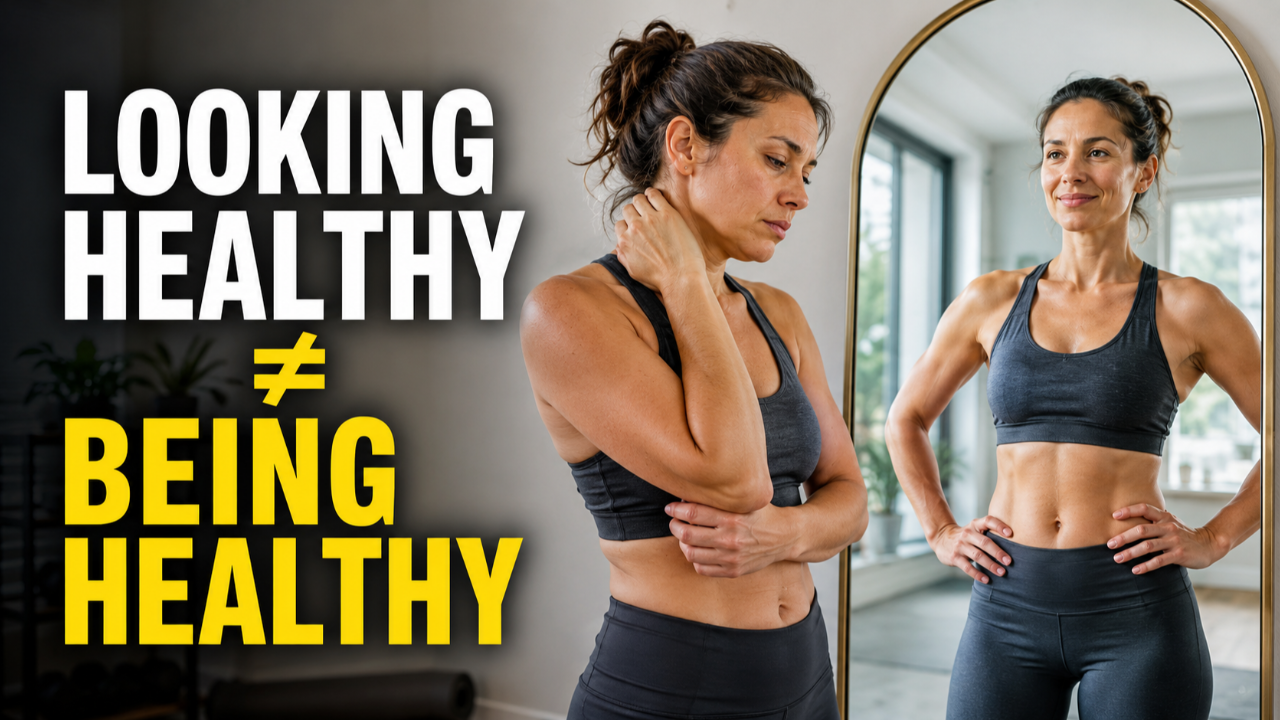
When did health become something we had to prove visually?
I do not mean that as a throwaway question. I mean it sincerely. When did health stop being something we experienced from the inside and become something other people were supposed to recognize from the outside? When did the body become a billboard for discipline, status, control, morality, success, and worthiness? Somewhere along the way, health became something we were expected to perform. Flat stomach. Clear skin. Expensive leggings. Green juice. The right shoes. The right water bottle. The right glow. The right body fat percentage. The right “effortless” discipline that somehow requires an enormous amount of effort to maintain.
And don’t get me wrong, I am not here to shame anyone for wanting to look good. I like looking good. I like feeling confident. I love a beautiful dress, a good workout, and yes, I will absolutely enjoy a tasty smoothie. I am not above aesthetics. I am not wandering through life in a burlap sack, judging everyone with contour and a gym membership. But looking healthy and being healthy are not always the same thing, and confusing the two can send people chasing the wrong goal.
Looking healthy is about what other people assume when they see you. Being healthy is about what your body allows you to experience. Those are not the same thing.
A six-pack does not tell me whether someone sleeps through the night. Visible muscle tone does not tell me whether their digestion works. A thin body does not tell me whether they have energy, joy, resilience, emotional regulation, meaningful relationships, or the ability to recover after stress. Your body is not a résumé. And yet, we have been trained to treat it like one.
The strange thing about body ideals is that they keep changing, which should make us suspicious. At one point in history, being plump could symbolize wealth, abundance, softness, leisure, and access to food. It meant you had enough. It meant you were not laboring all day just to survive. Now, in many circles, thinness, visible muscle tone, boutique fitness classes, expensive activewear, supplements, and wellness rituals symbolize discipline, money, control, and status. The symbol changed, but the human tendency stayed the same. We keep trying to read someone’s life from their body, as if the body were a moral report card.
But if the symbols keep changing, maybe the symbol was never the truth.
This is where things get dangerous. When health becomes visual, we start performing health instead of building it. We start asking, “What does this look like?” instead of “How does this feel?” We ask, “Will people notice?” instead of “Is my body functioning better?” We ask, “Does this make me look disciplined?” instead of “Is this helping me live a life I actually want to stay healthy for?”
That last question matters to me. It may be the whole point.
Because longevity without quality of life is not the goal. Living longer while feeling disconnected, inflamed, exhausted, anxious, lonely, resentful, and trapped is not freedom. The goal is not simply to extend life. The goal is to build a life that feels worth having energy for.
I have been reading The Longevity Project, and I am only on Chapter 6, so this is not my grand final analysis. I reserve the right to become retrospective and more capricious about it later. But even this early in the book, it has already started poking at some of the tidy little assumptions we love to make about health. We like simple formulas. Eat the perfect food. Do the perfect workout. Avoid stress. Stay happy. Be positive. Drink enough water. Smile in natural lighting while holding a salad. Congratulations, you have solved mortality.
Except, of course, humans are not that simple.
What has stood out to me so far is that the book is not pointing toward health as one isolated behavior or one polished image. It is pointing toward patterns. Personality. Responsibility. Relationships. Purpose. How people live over time. How they respond to life. How they work, connect, adapt, commit, recover, and keep going. That is far more interesting to me than another recycled lecture about broccoli and cardio. And I say that as someone who is very much in favor of broccoli and cardio. I simply do not think broccoli and cardio are enough to explain a human life.
That is where I think the wellness world often loses the plot. It loves the visible parts because the visible parts are easy to package and sell. A smoothie photographs better than emotional maturity. A matching yoga set photographs better than conflict resolution. A cold plunge photographs better than learning how to stop abandoning yourself every time someone is disappointed in you. A six-pack photographs better than a nervous system that knows how to return to safety after stress.
Wellness got branded. It became beige kitchens, name brand athletic wear, powders, apps, supplements, luxury retreats, cold plunges, perfect morning routines, and people filming themselves drinking something green while looking far more peaceful than anyone has ever looked at 5:00 in the morning.
Again, I am not against beautiful rituals. I love a ritual. I love a quiet morning. I love tea. I love movement. I love a nourishing meal. I love creating a life that supports my nervous system instead of constantly attacking it. But a wellness aesthetic is not the same as a well-lived life.
You can own the perfect water bottle and still ignore your body’s signals. You can eat organic and still live in a constant state of resentment. You can do yoga and still avoid every difficult conversation. You can look peaceful online and be completely dysregulated in private. You can be thin and exhausted. You can be strong and lonely. You can be cheerful and avoidant.
Happy is not the same thing as regulated. Cheerful avoidance is still avoidance. And pretending everything is fine is not the same as being well.
This is where I think our definition of health has to mature. Maybe health is not just what you eat, how you move, or what size pants you wear. Maybe health also includes how you respond to disappointment, how you handle conflict, how you recover after stress, how honest you are with yourself, how connected you are to others, how willing you are to change, and how much responsibility you take for your life without turning that responsibility into self-hatred.
That is a deeper definition of health. It is also a more useful one.
This matters because the people who are drawn to my work are usually not looking for another shallow wellness checklist. They are often people who already suspect that something about the mainstream version of health feels incomplete. They have tried the quick fixes. They have tried ignoring the pain. They have tried pushing through. They have tried being “good.” They have tried punishing themselves into change. And somewhere inside, they know health has to be about more than looking acceptable in public.
That is the heartbeat of Health Freedom for me. Health is not about becoming impressive. Health is about becoming available to your own life.
One of the things that stayed with me after studying in Japan was the feeling that not everything had to become a strategy. Not everything had to be optimized. Not everything had to become a productivity hack, a weight loss plan, a monetized identity, or a measurable outcome. I am not pretending to summarize an entire culture or religion in one tidy little paragraph. That would be ridiculous, and also deeply American of me. But one of the things I felt, especially around Shinto spaces and the rhythm of daily life, was a reverence for the act itself.
Doing something for the sake of doing it.
Cleaning because the space matters. Walking because walking is part of life. Preparing food with care because care belongs in the preparation. Running because running is the thing you are doing.
That stood out to me because in the United States, we are very good at turning every action into a means to an end. People run to lose weight. They run for cardio. They run to build endurance. They run to lower cholesterol. They run to look disciplined. They run to prove something to themselves, their neighbors, their ex, their doctor, their gym crush, or the imaginary committee in their head that is apparently always reviewing their life choices.
But what if you ran simply for the sake of running?
Here is the irony. If you run because you love running, or because it clears your mind, or because your body feels alive when it moves, many of the side effects people chase may still happen. Your weight may regulate. Your cardiovascular health may improve. Your legs may get stronger. Your endurance may increase. Your mood may shift. Your neighbor may notice. Your gym crush may notice. Or they may not, because your gym crush is not actually a public health metric.
But that was never the point.
The act was the point. The experience was the point. The life you get to live inside your body was the point.
That is how I feel about rock climbing. I started climbing because I needed a mental outlet while I was studying for my acupuncture board exams. My brain was overloaded. My nervous system needed somewhere to put all that pressure. I needed something that exhausted me physically and focused me mentally. Climbing gave me that. It was problem-solving with my whole body. It demanded presence. It gave my mind something to chew on besides anxiety, flashcards, and the never-ending pressure of becoming qualified to do the work I had spent years training for.
That was over twelve years ago. I no longer need climbing for that specific reason. The board exams are done. That chapter ended a long time ago. But I still climb.
Not because I am trying to prove I am fit. Not because I am trying to look like a professional climber. Not because I need every hobby to become a health goal. I climb because I climb. I climb because it is fun. Because it is humbling. Because it teaches patience. Because it makes me laugh. Because it lets me be strong and awkward at the same time. Because some routes feel impossible until suddenly they do not. Because the community is beautiful. Because my body and mind thrive on having a puzzle to solve.
And yes, climbing has health benefits. Of course it does. Strength, mobility, grip, coordination, confidence, social connection, stress relief, cardiovascular effort, body awareness, emotional resilience. Wonderful. I will take all of it. But those are the bonuses. They are not the soul of it.
That distinction matters because when every healthy action becomes a transaction, we eventually lose the joy that would have made the habit sustainable in the first place. If movement is only punishment for eating, eventually we resent movement. If food is only calorie equations, eventually we lose our relationship with nourishment. If rest is only something we earn after productivity, eventually our nervous system stops trusting us. If health is only about looking the part, eventually we become disconnected from the body we are supposedly trying to improve.
And the body knows when it is being used as a project instead of respected as a home.
One of the most harmful things about visual health culture is that it quietly teaches us to judge people’s character by their appearance. Thin must mean disciplined. Muscular must mean healthy. Soft must mean lazy. Tired must mean careless. Aging must mean weakness. Pain must mean failure. But bodies are more complicated than that. People can look healthy and be falling apart privately. People can carry extra weight and have strong labs, meaningful relationships, excellent endurance, and a joyful life. People can be recovering from illness, grief, trauma, burnout, childbirth, caregiving, injury, or years of survival mode. People can be doing their absolute best in a body that does not match the current wellness aesthetic.
And people can also be visually praised for habits that are quietly destroying them.
That is why we have to be careful.
The goal is not to look like health. The goal is to live in a way your body can survive, trust, and enjoy. That means health has to include internal experience. Can you sleep? Can you digest? Can you breathe deeply? Can you recover after stress? Can you move without constant fear? Can you feel joy without needing to earn it? Can you handle disappointment without collapsing or attacking yourself? Can you make changes without turning your life into a punishment? Can you take responsibility without hating yourself into action?
That is health too.
Maybe some of the most important signs of health are not visible at all.
This is where health becomes freedom. Because the point of being healthy is not to become a more impressive object. It is not to become a better before-and-after photo. It is not to become so visually acceptable that no one can criticize you. The point of health is to have access to your life.
To walk through a new city and not be limited by pain. To climb the stairs to the view. To play with your kids, your nieces, your nephews, your dogs, your friends, or whoever brings you joy. To travel without your body being the thing that stops you. To wake up with enough energy to be curious. To recover after a stressful week. To dance at the wedding. To garden. To swim. To hike. To climb. To laugh without bracing. To build something meaningful. To still be able to say yes to your life.
That is what I care about.
Not health as performance. Health as participation. Health as freedom. Health as the quiet, daily relationship you build with your body when no one is clapping, liking, measuring, or watching.
Because looking healthy is public. Being healthy is private. And the private part is where your actual life happens.
So maybe the question is not, “Do I look healthy enough?”
Maybe the better question is:
Am I building health, or am I performing it?
Keep moving, eat something green, and question anything that sounds like a quick fix.
Chow! Chow!