You Didn’t Lose Your Discipline. You Lost Your Structure.
Sep 08, 2026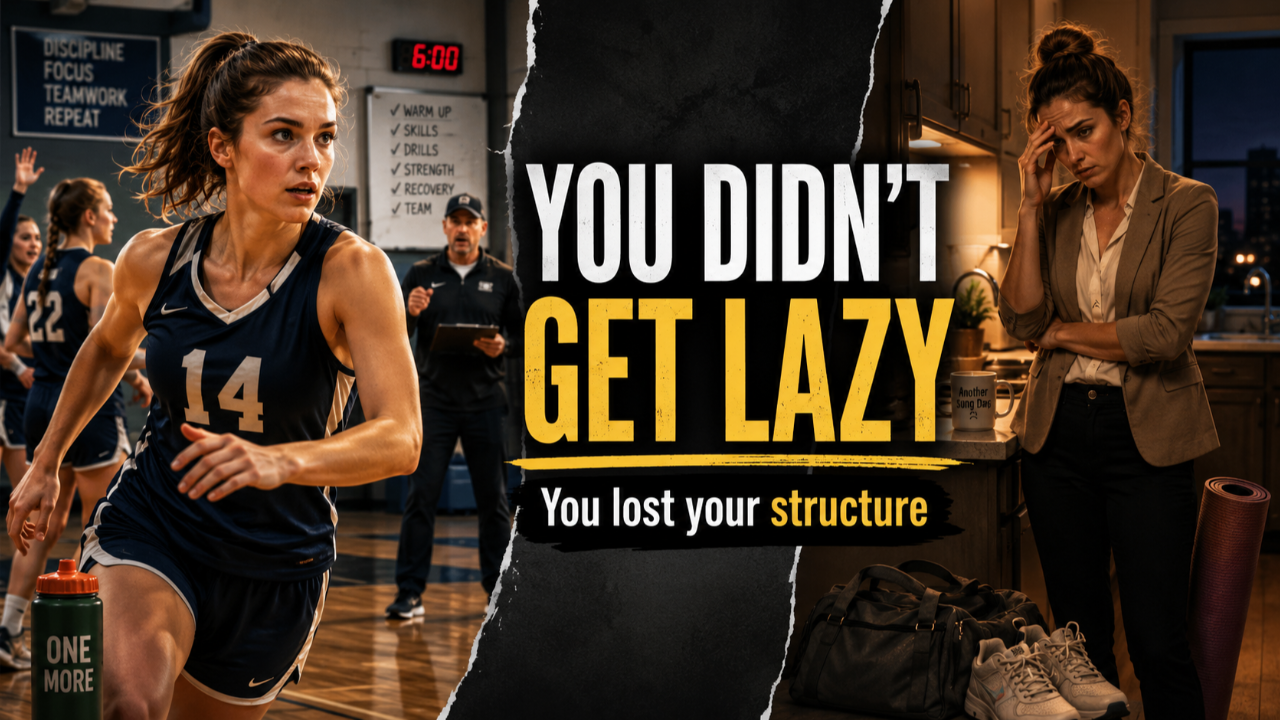
There is a particular kind of grief that comes from remembering how strong, capable, and active you used to feel.
It is not always dramatic. It does not usually arrive with violins and a single tear rolling down your cheek while you stare out a rainy window. Sometimes it shows up when you are standing in your kitchen at 7 p.m., still in your work clothes, staring into the refrigerator like it owes you an answer. You know you should probably move your body. You know you should probably eat something decent. You know you would feel better if you went for a walk, stretched, cooked, lifted something heavier than your phone, or did literally anything other than become one with the couch.
But you do not.
And then the shame starts.
What happened to me?
I used to be so disciplined.
I used to be an athlete.
I used to be strong.
I used to be consistent.
I used to have energy.
I used to be able to push myself.
Now I cannot even make myself go to the gym.
That is the moment a lot of former athletes mistake a structure problem for a character flaw.
They assume adulthood revealed some weakness in them. They think they became lazy, soft, unmotivated, undisciplined, or inconsistent. They compare their current life to the version of themselves who used to practice for hours, lift regularly, run drills, condition, compete, show up tired, show up sore, show up anyway.
But here is the truth I want more people to consider:
You did not become lazy.
You lost the structure that used to make discipline feel automatic.
You lost the team. The coach. The practice schedule. The weight room. The season. The competition. The accountability. The clear reason to train. The built-in community. The identity. The rhythm. The environment that made movement normal instead of optional.
And when that disappeared, no one handed you a manual for how to become your own coach.
I know this because I lived it.
I was a very active kid. I am an ’84 baby, which means there were no cell phones, no social media, no internet pulling me into a tiny glowing rectangle for hours a day. Hell, I barely had time to catch an episode of Saved by the Bell before school. Life happened outside. I played softball, volleyball, basketball, and street hockey with the neighbor kids. I climbed trees. I helped in the garden. I spent my summers running through the northern Michigan woods and swimming in the Manistee River or Glen Lake.
Movement was not a workout.
It was life.
It was play. It was transportation. It was social. It was competition. It was boredom relief. It was being a kid in a body that was constantly asked to run, climb, throw, jump, swim, dig, chase, and explore.
Then volleyball became the main thing.
Eventually that led to a full-ride scholarship, three-a-days, and a rigorous schedule of classes, practices, workouts, game days, travel, and expectations. My life was built around performance. There was no long inner negotiation about whether or not I felt like moving. It was on the schedule. People were waiting. A coach had a plan. My teammates were there. My body had a purpose. My effort had a direction.
Was it easy? No.
Was it always healthy? Also no.
But the structure was undeniable.
Then I stopped playing volleyball, moved to Colorado, and life changed.
I got a desk job working for a construction company. I was twenty years old, sitting at a computer, and slowly started to see and feel my body and mind change in a way that did not feel good. I gained weight. I lost muscle. I started having aches and pains. And good Lord, I felt old at twenty.
Twenty.
The age where your body is supposed to be made of elastic, optimism, and questionable decision-making.
I remember trying to go back to the gym because that is what you are “supposed” to do when you want to get back in shape. But I hated it. I hated working out alone. I hated the fluorescent lighting. I hated doing random exercises without a real reason. I hated that it felt like punishment instead of play. There was no team. No coach. No game. No season. No laughter between drills. No shared purpose. No one expecting me to be there.
It felt like trying to recreate being an athlete by removing everything that had made athletics meaningful.
So I quit the desk job.
I started working outside as a cart girl at a golf course, and almost immediately I felt better. I was outside. I was moving. I was away from the desk and the computer. I started playing golf. I walked the whole course. I felt my body waking back up again.
Then, because I was living in Colorado and apparently the state hands you hiking boots at the border, I got into hiking. I started losing the weight I had put on. I started gaining muscle back. I felt more like myself again.
But I still did not feel great.
Because, as it turns out, dating a chef who cooks very rich food, drinking a pot of coffee before noon, and then drinking a ton of wine at night is not exactly the royal road to vibrant health and wellness.
Shocking, I know.
So I did what a lot of people do when they realize their lifestyle is not working.
I went on a detox.
And after two weeks, I felt much better.
Then I went right back to my old lifestyle and felt the effects again.
This is the part we do not talk about enough. A temporary reset can show you what is possible, but it does not automatically give you a sustainable structure. A detox can make you feel better for two weeks. A challenge can give you momentum for thirty days. A meal plan can tell you what to eat. A workout program can tell you what to do.
But if your actual life is still organized in a way that keeps pulling you back into the same patterns, you will keep returning to the same results.
At some point, I realized I needed to learn more. Not just how to “detox,” but how to actually eat, live, move, and feel well in a way that could last longer than two dramatic weeks of herbal tea and self-righteousness.
So over the next several years, I used myself as an experiment.
I tried the diets. Paleo. Pescatarian. Gluten-free. Low carb. Vegan for three years, which is honestly when I felt the best for a long stretch of time. I read books. I watched documentaries. I took nutrition courses in college. I paid attention to how I felt physically, mentally, and emotionally.
Not just, “Did this make me look good?”
But did I have energy?
Was my mood better?
Was my digestion better?
Was my skin better?
Was my mind clearer?
Did this feel sustainable?
Did this make me more alive or just more controlled?
Eventually, I found a balance between all those experiments. These days, the closest label would probably be what Dr. Joel Fuhrman calls a Nutritarian: mostly whole, nutrient-dense plant foods, with an emphasis on what actually nourishes the body.
But that did not happen because one diet guru descended from the clouds and handed me the final truth on a laminated card.
It happened because I learned how to pay attention.
Food was only one part of the process. I was also experimenting with movement and realizing something very important about myself:
I do not like working out in a gym by myself.
I can do it. I have done it. I will probably do it again when it makes sense.
But it does not light me up.
And one of the most important things I learned after my athletic structure disappeared was that if I wanted movement to stay in my life, it needed to feel like more than exercise. It needed to feel like play, adventure, skill, community, or exploration.
So I joined hiking groups. I went to yoga classes. I started dancing two nights a week at local bars that offered lessons. I walked. I traveled. I explored cities on foot. And because travel became one of my great loves, I realized walking could not just be something I did when I was in a new place. It had to become part of my normal life too.
That was a huge shift.
I stopped trying to force myself back into the exact structure I lost, and I started building a new one that fit the person I was becoming.
That is the part former athletes often miss.
You are not supposed to be a college athlete forever.
And honestly, thank God.
Because as much as I loved being an athlete, I do not want to live the rest of my life like I am waiting for game day, proving my worth through performance, or punishing my body into obedience. I do not want to rebuild my health through shame, obsession, or a schedule that only works if I have no real adult responsibilities, no emotional life, no changing body, no work stress, and no desire to occasionally enjoy myself like a normal human being.
The goal is not to get your old life back.
The goal is to build a new structure that lets your body thrive now.
That distinction matters because I hear this story all the time. People say things like, “I used to play sports, but now I do not do much.” I have heard some version of that sentence in clinic rooms, massage rooms, acupuncture rooms, cruise ship treatment rooms, casual conversations, and passing comments from people who still recognize the athlete they used to be but do not know how to access that person anymore.
No one ever sounds happy saying it.
There is always something underneath it. Embarrassment. Grief. Nostalgia. Resignation. Sometimes even a little self-contempt.
I used to be that kind of person.
And every now and then, someone will ask me, “So, did you play volleyball or basketball?”
Typical. I am tall. It is the obvious question.
But then they follow it up with, “Do you still play?”
And I get to say, “No. I am a rock climber and a dancer now.”
They never see that answer coming, and it always makes me smile on the inside.
Because that sentence means something to me.
It means I did not lose the athlete in me. I let her evolve.
I do not need to be the volleyball player forever. I can be the climber. The dancer. The walker. The hiker. The woman who bikes to work. The traveler who can wander through a city all day. The practitioner who uses her body to help other bodies heal. The person who is still strong, still curious, still capable, still learning new ways to move through the world.
That is what I want for the people I work with.
Not to trap them in who they used to be.
Not to shame them for changing.
Not to tell them adulthood is just decline with better insurance.
Life changes.
That is not the failure.
That is the point.
The problem is that when life changes, your structure has to change with it.
If you were an athlete, your old structure may have been built for you. Practice was scheduled. Workouts were planned. Coaches corrected you. Teammates expected you. Seasons gave your training purpose. Competition gave your effort urgency. The environment carried a lot of the burden.
Then adulthood arrived and quietly removed the whole system.
Now no one is waiting at practice.
No one is programming your workouts.
No one is telling you when the season starts.
And yet somehow you are expected to keep the same level of discipline while also managing work, bills, relationships, kids, aging parents, groceries, stress, screens, laundry, appointments, and the existential weirdness of being an adult human in modern society.
No wonder people struggle.
That does not mean you are helpless.
It means you need a new container.
The goal is not to shame yourself into consistency. The goal is to rebuild the structure adulthood quietly removed.
That structure does not need to look like your old athletic life. In fact, it probably should not. You do not need three-a-days. You do not need to punish yourself into a cocoon of a human and call it discipline. You do not need to become a gym rat if you hate the gym. You do not need to cut all goodness from your diet, track every bite, optimize every morning, or make wellness your entire personality.
Please do not become the person who turns dinner into a hostage negotiation over macros.
We have enough suffering in the world.
What you need is a life that makes healthy choices easier to repeat.
That might mean joining a climbing gym instead of forcing yourself onto a treadmill you despise. It might mean signing up for dance lessons, adult leagues, hiking groups, yoga classes, pickleball, martial arts, rowing, swimming, cycling, or anything else that makes movement feel social, skillful, playful, or meaningful again.
It might mean finding a reason to train that is not rooted in self-hatred.
To climb better. To travel with energy. To keep up with your kids. To hike into your seventies. To carry your groceries without feeling like life has personally attacked you. To have better sex. To feel capable in your body again. To age with dignity. To be able to say yes to the life in front of you.
That is a very different motivation than “I hate my body, so I guess I should go suffer under fluorescent lights for forty-five minutes.”
Healthy structure also means food has to become livable. Not perfect. Not performative. Not a two-week detox followed by a return to the exact habits that made you feel terrible. It means learning what supports your body and building enough rhythm around it that eating well does not require a daily spiritual crisis.
For some people, that means meal prepping. For others, it means having three reliable breakfasts, five easy dinners, better snacks in the house, or simply not waiting until they are starving and emotionally unstable before deciding what to eat.
That last one is medically underrated.
It also means recovery has to be part of the structure.
Former athletes are often very good at effort and surprisingly bad at restoration. We know how to push. We know how to perform. We know how to override discomfort. We know how to ignore fatigue because the coach said one more sprint.
But adult health is not just effort.
It is effort plus recovery.
It is stress plus regulation.
It is challenge plus repair.
It is movement plus rest.
It is structure plus flexibility.
The older I get, the more convinced I am that health is not about becoming more rigid. It is about becoming more responsive. Knowing when to push and when to pause. Knowing when your body needs intensity and when it needs a walk. Knowing when discipline means showing up and when discipline means going to bed.
That is not weakness.
That is wisdom.
And let me be very clear: this is not about getting old.
I feel better now than I did in my twenties.
Not because I found one perfect system and never deviated from it. Not because I became obsessively disciplined. Not because I cut all pleasure out of my life and ascended into some joyless wellness cloud.
I feel better because I spent years learning what my body needs to thrive.
Honestly, it took most of my thirties to really get a handle on it. And I am sure life will ask me to reevaluate it again. That is what life does. It changes the terrain. It changes the season. It changes the demands. It changes your body, your schedule, your priorities, your relationships, your work, your environment.
So the question is not, “How do I find the one perfect routine forever?”
The question is, “How do I become someone who knows how to build and rebuild a life that supports my health?”
That is the work.
And that is the direction my future work is moving.
I want to help people gain insight into their actual world — personally, physically, emotionally, practically, environmentally. Not the fantasy version of their life where they wake up refreshed, meditate for thirty minutes, cook every meal from scratch, work out joyfully, have perfect boundaries, and never scroll on their phone while wondering what happened to their will to live.
Your actual life.
Your real schedule.
Your real stress.
Your real preferences.
Your real history.
Your real body.
Your real environment.
Your real reasons for wanting to feel better.
Because once you understand those things, you can stop trying to force yourself into a rigid system that was never designed for you and start building one that actually supports you.
That is the difference between giving someone a fish and teaching them how to fish.
I do not want people dependent on me forever. I do not want people thinking health only works if someone else tells them exactly what to do every day. I want people to learn themselves well enough that they know how to care for themselves through different seasons of life.
I want people to understand their bodies.
I want them to build self-trust.
I want them to know how to return to movement after life gets weird.
I want them to know how to eat in a way that supports energy without turning food into fear.
I want them to know how to create accountability without shame.
I want them to know how to rest without guilt.
I want them to know how to ask for support without feeling like they failed.
I want them to feel free in their bodies — not just now, but as they age.
Because no one can be a college athlete forever.
And that is okay.
You are allowed to become something else.
You are allowed to reinvent your movement.
You are allowed to redefine strength.
You are allowed to outgrow the structure that once shaped you and build a new one with more wisdom, more freedom, and hopefully a lot more joy.
Maybe you are not lazy.
Maybe you are not broken.
Maybe you are not undisciplined.
Maybe you are standing in an adult life that no longer contains the structure that once helped you thrive.
So stop asking, “What happened to me?”
Ask something better.
What structure did I lose?
What kind of support do I need now?
What kind of movement would make me feel alive again?
What kind of food helps me feel clear, steady, and strong?
What kind of environment makes healthy choices easier?
What kind of identity am I ready to build next?
You did not lose your discipline.
You lost your structure.
Now it is time to build one that fits the life you are actually living.
Let’s go!
Keep moving, eat something green, and question anything that sounds like a quick fix.
Chow! Chow!