Health as Capacity, Not Control
Aug 11, 2026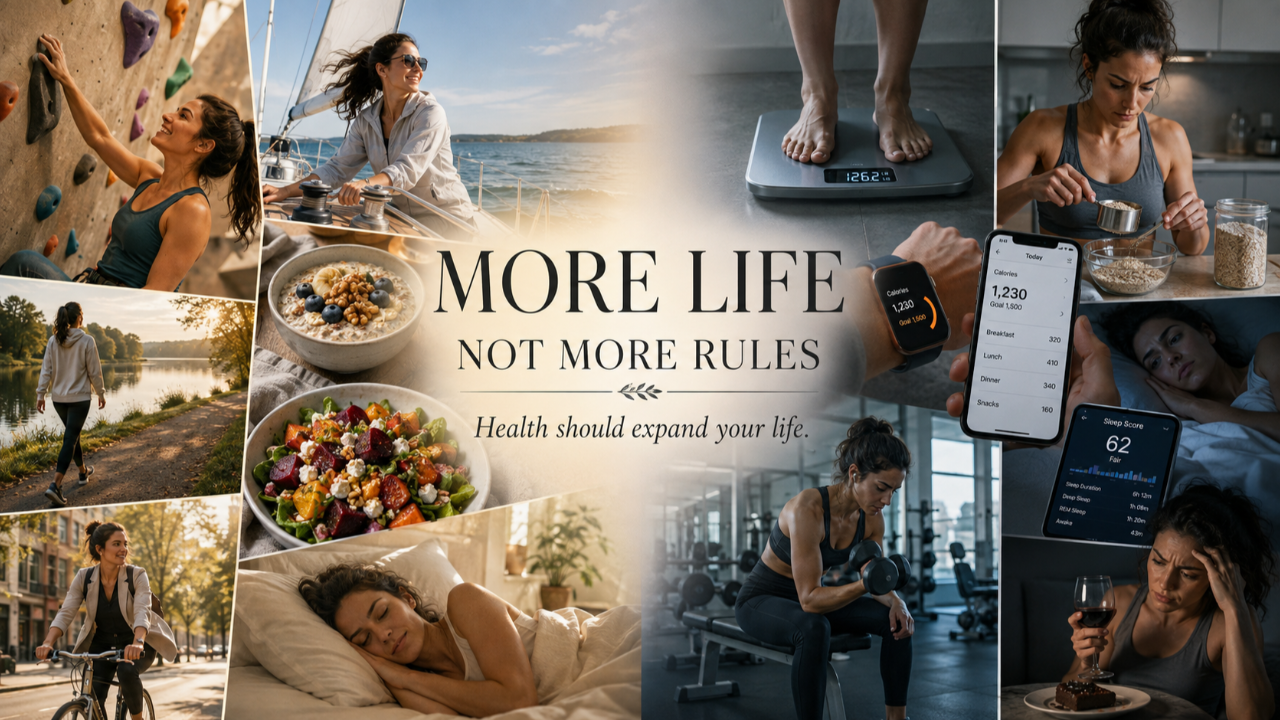
"I Don’t Want a Perfect Body. I Want One That Lets Me Live."
Somewhere along the way, a lot of people stopped trying to become healthy and started trying to become controllable.
Control the calories. Control the macros. Control the weight. Control the workout. Control the body fat. Control the cravings. Control the wrinkles. Control the schedule. Control the morning routine. Control the blood sugar, the inflammation, the hormones, the steps, the sleep score, the water intake, the supplement stack, and the suspicious little emotional spiral that happens when a birthday party has cake and no one brought a “clean” option.
And listen, I understand why control feels attractive.
When your body feels unpredictable, control feels like safety. When you have pain, fatigue, inflammation, anxiety, digestive issues, brain fog, weight changes, or hormonal chaos, it makes sense that you would want something solid to hold onto. Rules feel solid. Numbers feel solid. Plans feel solid. A food tracker, a workout calendar, a supplement routine, a scale, a smartwatch, and a perfectly organized refrigerator can all create the feeling that maybe you finally have a grip on things.
But here is where it gets tricky.
Sometimes the thing we call health is not actually health. Sometimes it is fear with better branding.
Sometimes it is obsession dressed up as discipline. Punishment dressed up as accountability. Comparison dressed up as inspiration. Exhaustion dressed up as ambition. Restriction dressed up as “clean eating.” Self-criticism dressed up as high standards. A cage with a wellness label slapped on the front.
And I do not think enough people are willing to say that out loud.
Because the current wellness culture often rewards the appearance of control. It praises the person who never misses a workout, never eats the cake, never skips the supplement routine, never relaxes into a meal without calculating what it costs, never admits they are tired, never allows their body to soften, age, fluctuate, rest, or simply be human without turning it into a project.
It looks impressive from the outside.
But does it feel like freedom?
That is the question I care about.
Because health should not become another cage. It should expand your life. The point is not to become the most disciplined person in the room. The point is to have a body that lets you live with more freedom, aliveness, and trust.
The goal is not to look like you have your life together.
The goal is to have a body that lets you live it.
I see this all the time in real life, not just online. Someone starts trying to “get healthy,” but what they really mean is they are going to tighten the rules until their life starts to shrink. They stop going out to dinner because they do not know what oil is in the food. They stop enjoying movement because every workout has to be productive, measurable, and worthy of being logged. They turn meals into math problems. They turn rest into a scoring system on their watch. They turn their body into a daily performance review. They are not more alive. They are more managed.
And somehow, we are supposed to call that wellness.
I have watched people get praised for looking healthy while living in a body that is exhausted, tense, underfed, overtrained, anxious, inflamed, and deeply disconnected. I have watched people with visible muscle tone struggle to sleep. I have watched people with beautiful routines have no emotional flexibility when life interrupts them. I have watched people become so attached to “doing everything right” that one missed workout or one imperfect meal sends them into shame, panic, or self-punishment.
That is not health.
That is a nervous system trying to earn safety through control.
And on the other side, I have watched people assume they are failing because their body does not match the current wellness aesthetic, even though they are doing deeply healthy things. Walking consistently. Cooking more. Sleeping better. Drinking less. Getting treatment. Stretching. Setting boundaries. Recovering from burnout. Learning how to eat without punishment. Learning how to move without hating themselves. Learning how to live inside their body with contentment instead of constantly trying to defeat it.
That counts.
Even if it is not dramatic enough for a before-and-after photo.
This is one of the biggest problems with the modern wellness conversation: we have confused visible control with real health.
Looking healthy and being healthy are not the same thing. Looking disciplined and living well are not the same thing. Having a body that photographs well and having a body that lets you walk, climb, dance, travel, garden, work, rest, love, digest, sleep, and age with dignity are not the same thing.
Real health gives you more life, not more rules.
That does not mean rules are always bad. Structure can be helpful. Routines can be grounding. Food choices matter. Movement matters. Sleep matters. Alcohol matters. Stress matters. Personal responsibility matters. I am not here to pretend that health is just vibes and permission slips. Your choices absolutely shape your body and your life.
But the question is: are your choices making your life bigger or smaller?
That is where honesty has to enter the room, preferably before the wellness industry sells you another performance powder or lumbar support gadget that also massages you.
If your health plan makes you afraid of food, is that health? If your workout routine makes you ignore pain, is that health? If your discipline makes you unavailable for joy, connection, rest, pleasure, spontaneity, and real human life, is that health? If your body looks “better” but your mind is more anxious, your relationships are more rigid, your days are more controlled, and your nervous system never feels safe, what exactly did you win?
A smaller life in a more socially approved body?
No thank you.
That is not the kind of health I am interested in.
The kind of health I care about is the kind that helps someone get their life back. I care about the person who can finally go for a walk without worrying whether their back will seize. I care about the person who sleeps through the night after months of staring at the ceiling. I care about the person who can eat a meal without fear, digest without drama, and trust their body enough to leave the house without planning their entire day around symptoms. I care about the person who has enough energy to cook, laugh, create, work, parent, travel, climb stairs, garden, dance at the wedding, sit on the floor with their grandkids, or simply get through the day without feeling like their body is a badly managed group project.
That is health.
Not perfection.
Availability.
Can you be available to your life? Can you participate in it? Can you say yes to things without doing a full-body risk assessment first? Can you recover after stress? Can you enjoy food without turning it into a moral trial? Can you move because your body is alive, not because your body needs to be punished? Can you rest before collapse? Can you trust yourself enough to make choices that support you without turning every choice into a courtroom drama?
That is the difference between control and real health.
Control asks, “How do I make my body obey?”
Real health asks, “What kind of life helps my body trust me?”
Control says, “You are only okay if you follow the rules.”
Real health says, “You are allowed to build a body and life that can bend without breaking.”
Control turns the body into a project.
Real health turns the body into a partner.
And that partnership matters because the body is not something you drag behind your ambitions. It is the place where your entire life is happening. Your body carries you into conversations, relationships, kitchens, treatment rooms, airports, parks, beds, grief, joy, work, pleasure, and change. If health does not make that life more possible, more meaningful, more spacious, and more livable, then we need to ask whether we are pursuing health or simply obeying a culture that taught us to fear being human.
This is where comparison becomes especially dangerous.
Because so many people are not actually listening to their bodies. They are listening to someone else’s body online. Someone else’s routine. Someone else’s metabolism. Someone else’s genetics. Someone else’s income, schedule, job flexibility, childcare support, lighting, camera angle, supplement discount code, or ability to spend two hours making a salad that looks like it has a publicist.
And then they wonder why their own life feels like failure.
Of course it does. You cannot build real health by abandoning your actual life to imitate someone else’s highlight reel.
Your body does not need you to become an influencer’s Tuesday morning. Your body needs you to become honest about your own.
What does your body need in the life you are actually living? Not the fantasy life. Not the someday life. Not the life where you wake up glowing at 5 a.m., meditate under a sunbeam, cook breakfast from scratch, stretch, journal, answer emails with emotional maturity, and somehow never spill coffee on yourself. I mean the real one. The one with work, bills, fatigue, weather, cravings, laundry, pain, relationships, stress, and the occasional dinner made of whatever can be assembled before your will to live leaves the kitchen.
What would help that body feel more supported?
That is the question.
Not how do you become perfect. Not how do you control every variable. Not how do you earn the right to feel okay in your body. How do you support the body that is carrying you through your actual life?
Maybe the answer is not another rule. Maybe it is an earlier bedtime. Maybe it is fewer workouts that punish you and more movement that builds trust. Maybe it is eating more real food without turning your kitchen into a moral courtroom. Maybe it is drinking less because your nervous system is tired of processing alcohol and emotional avoidance at the same time. Maybe it is taking your pain seriously. Maybe it is getting acupuncture, massage, physical therapy, counseling, bloodwork, or whatever support your body has been asking for while you kept insisting you were “fine.”
Maybe it is looking at your health plan and asking one honest question:
Is this giving me more life, or is it just giving me more control?
That is something practical you can do today.
Look at one habit, rule, routine, or health goal you are currently trying to follow. Then ask: does this help me live more fully? Does it give me energy, steadiness, strength, clarity, peace, connection, trust, or joy? Or does it make my life smaller, harsher, more anxious, more rigid, more obsessive, and more disconnected from the person I actually want to become?
If it gives you more life, keep building it.
If it only gives you more control, it may be time to tell the truth.
Because the body does not need to be controlled into submission. It needs to be cared for with enough honesty and consistency that it starts to believe you are on the same team. And yes, that still requires responsibility. Please do not mistake this for a permission slip to ignore your health and call it freedom. That is not freedom either. That is just neglect wearing a cute hat.
Freedom is not “I do whatever I want and my body deals with it.”
Freedom is “I make choices that allow me to participate in the life I want.”
Sometimes that means saying no. Sometimes that means eating the vegetables. Sometimes that means going for the walk. Sometimes that means leaving the party early, booking the appointment, drinking water, doing the exercises, setting the boundary, resting before the crash, or choosing the less dramatic option that your future self will be quietly grateful for.
That is not a cage.
That is care.
The difference is whether the choice is rooted in fear or rooted in respect.
A fear-based health plan says, “I have to do this because my body is unacceptable.”
A respect-based health plan says, “I choose this because my life matters, and my body is how I get to live it.”
That is the kind of health I actually care about.
Not the kind that wins the comparison game. Not the kind that makes strangers assume you have discipline. Not the kind that turns every meal, workout, and body signal into evidence for or against your worthiness. I care about the kind of health that makes your life bigger. The kind that gives you more options, more energy, more trust, more resilience, more room to be human.
I do not want a perfect body.
I want a body that lets me live.
And I want that for you too.
Keep moving, eat something green, and question anything that sounds like a quick fix.
Chow! Chow!