Healthy Humans Need Healthy Habitats
Jul 28, 2026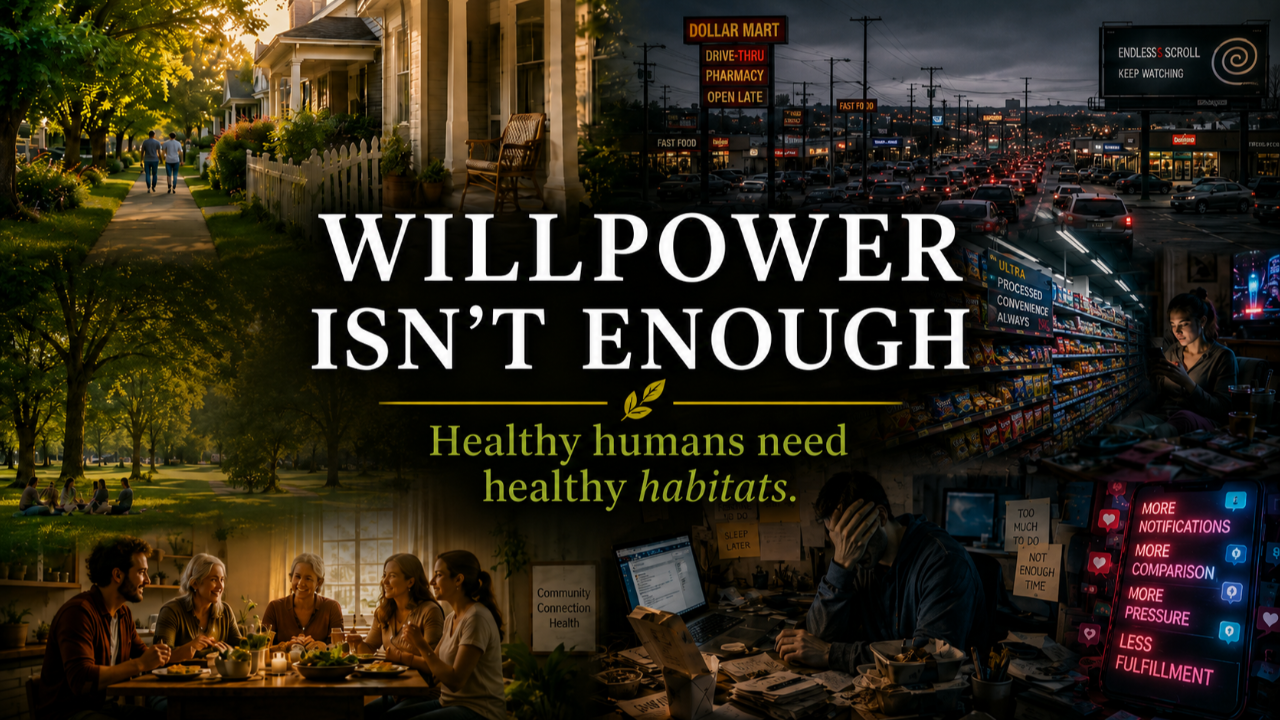
A healthy life does not happen in a vacuum.
It happens in homes, neighborhoods, kitchens, workplaces, friendships, grocery stores, routines, sidewalks, parks, calendars, conversations, and communities. It happens in the places where people actually live, not in the fantasy version of life where everyone wakes up rested, makes a beautiful breakfast, meditates peacefully, walks to the farmer’s market, prepares a colorful lunch, moves their body, regulates their nervous system, and still has the emotional capacity to be kind in traffic.
That version of health advice is very cute. It also often ignores the actual world people are living in.
Most health advice still talks to people as if the problem is simply motivation. Eat better. Move more. Sleep more. Stress less. Drink water. Get sunlight. Cook at home. Put your phone away. Make time for connection. Breathe. Stretch. Rest. And sure, yes, most of that advice is not wrong. I have probably said all of it myself. I will absolutely continue telling people to eat something green and question anything that sounds like a quick fix.
But the missing piece in most health advice is environment.
Because health does not happen because someone heard the right tip. Health happens when the healthier choice becomes realistic, repeatable, and supported by the life around them. A healthy body is not built by willpower alone. It is built through a life that supports the healthy version of you.
That matters because modern life is often designed in the opposite direction.
The unhealthy choice is frequently the easiest choice. Processed food is fast, cheap, available, aggressively marketed, and engineered to be hard to stop eating. Work is often sedentary, stressful, and overconnected. Rest is treated like laziness. Sleep is sacrificed to productivity, screens, stress, and the strange belief that adulthood means being permanently behind. We are overfed and undernourished, connected online and lonely in real life, overstimulated and uninspired, surrounded by options and starving for meaning.
Then we act shocked that people are tired, inflamed, anxious, distracted, lonely, in pain, dysregulated, and struggling to make “better choices.”
Of course they are struggling.
Many people are trying to build healthy habits inside unhealthy habitats.
That does not mean personal responsibility does not matter. It does. I will never be interested in a version of health that removes responsibility completely and turns every human into a helpless victim of their circumstances. Your choices matter. Your food matters. Your sleep matters. Your movement matters. Your boundaries matter. Your willingness to participate in your own healing matters.
But personal responsibility does not exist in empty space.
Environment shapes what becomes normal. It shapes what becomes convenient, socially acceptable, affordable, accessible, and emotionally familiar. It shapes whether movement is built into your day or something you have to schedule, drive to, pay for, and force yourself to do after sitting for eight hours. It shapes whether real food is easy to find or whether the nearest options are gas station snacks, drive-through meals, and something wrapped in plastic that technically contains oats but has the spiritual energy of a cookie pretending to have a LinkedIn profile.
Environment matters.
Think about the difference between living somewhere you can walk to a park, a coffee shop, a grocery store, a friend’s house, the lake, or the farmer’s market, versus living somewhere every single errand requires a car. Think about what happens to a body when movement becomes part of daily life instead of another obligation added to an already exhausted schedule. Think about the difference between a neighborhood with sidewalks, trees, front porches, gardens, benches, safe crossings, and people who know each other’s names, versus one where everyone disappears into garages and waves only through windshields.
Those are not just lifestyle preferences. They are health inputs.
Walkable towns are health infrastructure. Parks are health infrastructure. Front porches are health infrastructure. Shared meals are health infrastructure. Gardens are health infrastructure. Community spaces are health infrastructure. Kitchens that are actually used are health infrastructure. Friendships that make it easier to be well are health infrastructure. A neighbor who notices you have not been outside in a few days is health infrastructure. A routine that makes sleep easier is health infrastructure. A workplace that does not require people to abandon their bodies in order to be considered productive is health infrastructure.
Health infrastructure is not just hospitals.
It is sidewalks, kitchens, porches, parks, and people who know your name.
This is one of the reasons I keep coming back to the idea that healthy humans need healthy habitats. Because somewhere along the way, we started treating health like it was only an individual project. As if the body is supposed to become healthy through personal discipline while living inside environments that constantly pull it in the opposite direction. As if we can tell people to relax while their calendars are overstuffed, their phones never stop buzzing, their jobs reward over-functioning, their neighborhoods require driving everywhere, their food systems push cheap hyper-palatable calories, and their social lives have been reduced to likes, texts, and occasional plans everyone is too tired to keep.
Then when people struggle, we call it a discipline problem.
That is too small.
It is also too convenient.
Because if the whole problem is personal discipline, then we never have to ask harder questions about the lives we have normalized. We never have to ask why so many people are lonely. Why so many people are exhausted. Why cooking feels impossible. Why movement has become optional instead of ordinary. Why stress is treated as the cost of being successful. Why rest has to be justified. Why children are driven to playdates instead of running through neighborhoods. Why adults can live next to each other for years and never really know one another. Why people can be surrounded by food and still be undernourished.
These are not just personal problems.
They are habitat problems.
And yet, this is where I want to be careful. Because it is tempting to hear this and think, “Well, great. The whole system is broken, so I guess there is nothing I can do except lie on the floor and become one with the dust.”
No.
That is not the point.
The point is not to use environment as an excuse to give up. The point is to stop pretending environment does not matter and then start designing your life with that truth in mind. A healthy life must be designed, not just desired.
That design can begin small. You may not be able to redesign your entire town, quit your job, build a front porch, create a village, and install a farmers market outside your kitchen window by next Thursday. Annoying, I know. But you can look at the habitat of your own daily life and ask better questions.
Does my kitchen make healthy eating easier or harder? Does my evening routine support sleep or sabotage it? Do my closest relationships help me become more honest, grounded, and alive, or do they keep me in patterns of stress and self-abandonment? Does my home invite rest or constantly remind me of unfinished tasks? Does my schedule contain any space for recovery, or have I built a life where my nervous system is expected to sprint forever in shoes it did not agree to wear?
What is normal in your life right now?
That may be the most important question.
Because what is normal becomes easy to repeat. If it is normal to stay up too late, that becomes easy to repeat. If it is normal to keep soda in the house, that becomes easy to repeat. If it is normal to eat in the car, skip walks, scroll at night, avoid sunlight, cancel plans, say yes when you mean no, and treat stress like a personality trait, those things become easy to repeat. Not because you are weak, but because the habitat keeps cueing the pattern.
The good news is that healthier patterns can also become normal when the habitat supports them.
Put the walking shoes where you see them. Keep food in the house that makes nourishment easier. Make your bedroom feel like a place your nervous system can actually land. Create a morning that does not begin with immediate digital assault. Build friendships around walks, meals, coffee, gardens, movement, creativity, and showing up in real life. Choose spaces that make you feel more human when you can. Spend time outside. Know your neighbors. Sit on the porch. Go to the park. Cook with someone. Join something. Create rituals that are not about optimization, but about belonging to your own life.
This is not about becoming perfect.
It is about making the healthy choice less heroic.
Because if every healthy choice requires a battle, eventually you will get tired of fighting. That is not failure. That is human. Willpower is useful, but it is not a habitat. It is not meant to carry the full weight of your health forever. Willpower is for moments. Habitat is for patterns.
And patterns build lives.
This is why I do not want health to remain trapped in the language of discipline alone. Discipline matters, but it is not the whole story. People do not just need more discipline. They need better design. Better support. Better rhythms. Better spaces. Better community. Better reasons to choose health besides fear, shame, weight loss, or trying to become visually acceptable to strangers on the internet.
They need a life where health belongs.
A life where movement is not punishment, food is not a moral test, rest is not laziness, and connection is not something squeezed into the leftover scraps of an exhausted week. A life where the body is not treated like an inconvenience that must be managed, but as the place where life is actually happening.
That is what a healthy habitat does. It does not make every choice for you. It does not remove responsibility. It does not guarantee that you will never struggle, never crave, never spiral, never skip the walk, never eat the crackers over the sink while staring into the middle distance like a Victorian widow. Again, some of us have lived.
But it changes the odds.
It makes health more natural. It makes repair easier. It makes connection more available. It makes movement more ordinary. It makes nourishment more likely. It makes rest more believable. It gives the healthy version of you somewhere to live.
That is the line I keep coming back to.
A healthy body is not built by willpower alone. It is built through a life that supports the healthy version of you.
And that does not mean waiting until you can create the perfect environment. The perfect environment does not exist. Every life will have friction. Every home has limitations. Every community has gaps. Every schedule has seasons that make health harder. But even small design changes matter because they shift the default.
And the default matters more than motivation.
Motivation comes and goes. The default is what catches you when motivation leaves the room. The default is what you eat when you are tired. It is whether you walk because the path is inviting or sit because the couch is easier. It is whether your friendships revolve only around alcohol and complaints or whether some of your people also know how to walk, cook, laugh, think, rest, and grow with you. It is whether your home makes it easier to sleep or easier to stay stimulated. It is whether your life keeps pulling you toward depletion or quietly reminds you that you are allowed to recover.
So maybe the question is not, “Why don’t I have more willpower?”
Maybe the better question is, “What kind of habitat am I trying to be healthy inside?”
That question is not soft. It is strategic.
It asks you to look around and tell the truth. What in your life is helping you heal? What is helping you stay stuck? What keeps making the unhealthy choice the easiest choice? What could be rearranged, removed, added, softened, strengthened, or protected? Where do you need more support? Where do you need better boundaries? Where do you need people? Where do you need nature? Where do you need a kitchen that works, a schedule that breathes, a bedtime that holds, or a community that makes being well feel less lonely?
Because healthy humans need healthy habitats.
And if your current habitat keeps asking your body to survive stress, isolation, poor food, limited movement, overstimulation, and exhaustion, then the answer is not just to scold yourself into better choices. The answer is to build a life where better choices can actually take root.
That is health freedom too.
Not just a healthier body.
A healthier world for that body to live in.
Keep moving, eat something green, and question anything that sounds like a quick fix.
Chow! Chow!