The Myth That Being Healthy Is Expensive
May 26, 2026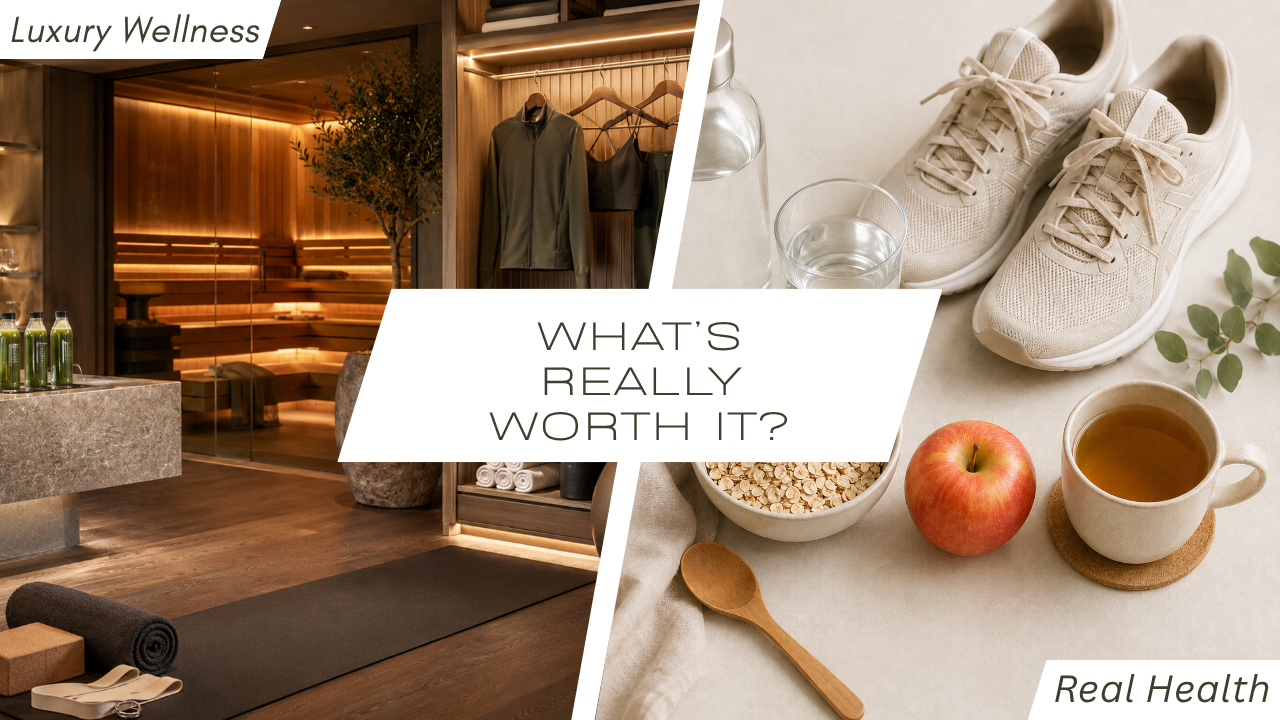
You’re going to pay for your health one way or another. The question is how.
People are funny about money.
I was at the airport recently, flying back from Germany, standing in line to buy water — because apparently airports are where hydration goes to become a luxury item — when I overheard a woman comparing water prices with her friend.
“Just get the cheap one,” she said.
Reasonable. Practical. Financially responsible. I respect it.
But then, not even two minutes later, they spotted a display of wild, colorful socks. You know the kind — bananas wearing sunglasses, cats riding skateboards, something that looks like it was designed during a fever dream. Suddenly, the same woman who had been carefully analyzing the water prices was perfectly willing to pay ten euros for one pair of socks.
And listen, I am not anti-sock. I love a good ridiculous purchase. I have absolutely spent money on things that made no sense except that they made me happy. Life needs some nonsense.
But it made me think.
Why do we obsess over the price of things that sustain us, but barely blink at the price of things that entertain us?
To some people, a clean bottle of water is priceless. It is survival. It is dignity. It is health in its simplest form. To others, it is just the boring thing you resent paying for while the novelty socks get all the emotional enthusiasm.
And honestly, that sums up the way a lot of people treat health.
We say we cannot afford to be healthy, but we are constantly spending money on things that either distract us from our body or slowly make our body feel worse. We act like healthy living requires a luxury grocery store, a private chef, a $500 monthly wellness club, and a nervous system that has never opened an insurance bill.
But does it?
Or have we been sold a version of health that is so expensive, complicated, sterile, and joyless that most normal people look at it and think, “Well, clearly that’s not for me.”
Because somewhere along the way, health got branded.
It stopped being water, food, sleep, movement, sunlight, peace, friendship, and basic respect for your body. It became organic everything, boutique fitness, biohacking, smart watches, powdered mushrooms, cold plunges, lymphatic drainage tools, luxury retreats, and supplements with names that sound like they were invented by a Silicon Valley wizard.
And don’t get me wrong. I love a good wellness tool. I like nice things. I appreciate a sauna. I enjoy kombucha. I have absolutely wandered through Whole Foods admiring the natural soap aisle like it was a tiny botanical museum.
But health is not Whole Foods.
Health is not a brand.
Health is not a matching yoga set.
Health is not a $300 Japanese knife sitting untouched in a fancy kitchen while the person who owns it orders fast food delivery because cooking feels overwhelming.
And I’m not judging the knife. I love a good knife. But let’s not pretend the carrot was the expensive part.
The truth is, people confuse luxury wellness with actual health.
Actual health is much simpler. Not always easy, but simple.
Drink water. Eat food that gives your body something useful. Sleep enough that your brain doesn’t feel like it’s being operated by a raccoon with a flashlight. Move your body in ways it was designed to move. Learn how to calm yourself down before stress starts decorating your internal organs.
That’s the foundation.
And yes, every person is different. Of course they are. What works for a college athlete is not the same as what works for a new mom, a stressed executive, a retired fisherman, a recovering patient, a 22-year-old living on ramen, or a 60-year-old who just realized they want to hike in Italy without negotiating with their knees.
There is no one-size-fits-all version of health.
That’s the problem with most health advice. Someone eats bee pollen for six months, feels amazing, makes a video, and suddenly half the internet thinks bees are the new primary care provider.
Please don’t do that.
Your body has nuance. Your lifestyle has nuance. Your history, stress, culture, schedule, finances, and preferences all matter.
But the basics? The basics are not complicated.
I grew up in Michigan, and at one point Michigan was considered one of the unhealthiest states in the country. Then I moved to Colorado, which was often considered one of the healthiest. And one of the funniest ways I learned to gauge the health of a community was by looking at what the convenience store sold.
In Michigan, the convenience store was often a wall of sugar, processed snacks, energy drinks, donuts, and hot dogs that looked like they had been rotating since the Clinton administration.
In Colorado, you could walk into a gas station and find organic popcorn, apples, avocados, bananas, kombucha, and salads.
Then I went to Japan, and the convenience stores had sushi, bento boxes, rice cakes, matcha tea, and food that actually looked like food.
Same idea: quick, convenient food.
Totally different cultural assumptions about what a person might grab when they are hungry.
That matters.
Because health is not just personal. It is environmental. It is cultural. It is what is easy. It is what is normal. It is what surrounds you until you stop questioning it.
If everyone around you is tired, inflamed, achy, stressed, overmedicated, under-slept, and joking about falling apart at 35, eventually that starts to look normal.
But common does not mean normal.
It just means popular.
I remember being in the locker room at a climbing gym and overhearing a woman say to her friend, “No one tells you that when you turn 35, your body starts falling apart.”
I was 37 or 38 at the time, and I remember thinking, “Wait… mine didn’t.”
In fact, I felt better then than I did at 20.
Not because I’m perfect. Not because I have some magical genetic lottery ticket. Not because I live every day like a wellness monk who only eats sprouted things and whispers affirmations to kale.
I feel better because I have spent years making small deposits into my health.
Morning walks. Tea before bed. Baths. Rock climbing. Dancing. Reading. Camping. Overnight oats. Laughing with friends. Learning how to cook. Learning how to listen to my body. Learning how to stop making everything so dramatic and just do the small thing that helps.
None of that requires a luxury membership.
Walking is free. The watch tracking your steps may cost money, but the steps are yours.
Sleep is free. Yes, you can buy fancy sheets, a perfect mattress, and a pillow engineered by Scandinavian sleep scientists, but sleep itself is free. And somehow we treat it like the most unproductive part of the day, when it may be the most productive thing your body does.
Relaxing is free too, although apparently we have made it emotionally difficult.
And movement? Movement does not always mean a workout.
Sometimes movement is using your body like you still plan to have one later.
I am six feet tall. I wear heels regularly. If I need to pick something up from the floor or grab something from a bottom shelf, I squat. I do not fold myself in half like a sad lawn chair and then wonder why my low back hates me. I use my legs. I use my knees. I let my hips do hip things.
That is free.
Using your body correctly is free.
And yet, so many people spend a fortune later trying to undo the consequences of not doing it. Expensive massages. Physical therapy. Pain medication. Braces. Devices. All because somewhere along the way, they stopped using their body for what it was built to do — or they stopped using it much at all.
That’s not aging.
That’s poor mechanics with a long-term payment plan.
And this is where the money conversation gets interesting.
Because people say being healthy is expensive.
But poor health? Poor health is wildly expensive.
A long commute is expensive. Six hours of TV every night is expensive. Fast food delivery multiple times a week is expensive. Chronic stress is expensive. Poor sleep is expensive. Ignoring your body until it forces you to pay attention is expensive.
You are going to pay for your health one way or another.
You can pay in small increments over time: groceries, walking shoes, a gym membership if you actually use it, acupuncture, bodywork, a course, better habits, time outside, decent food, and a bedtime that doesn’t require your nervous system to file a formal complaint.
Or you can pay later in massive, terrifying installments: medications, surgeries, missed work, procedures, insurance premiums, chronic disease, pain, exhaustion, and a life that slowly gets smaller because your body can no longer carry your choices.
That’s the real cost.
Not just money.
Freedom.
Because the cost of poor health is saying no to the hike. No to the trip. No to dancing. No to intimacy. No to playing with your kids. No to walking after dinner. No to the version of yourself who still wants to live with energy, curiosity, and joy.
And that brings me back to the fisherman and the businessman story.
You know the one. The businessman sees the fisherman relaxing and tells him he should work harder, build a bigger business, make more money, expand, scale, hustle, grind, and eventually retire so he can relax by the water and enjoy life.
And the fisherman is basically like, “I’m already doing that.”
That story haunts me in the best way.
Because sometimes we are chasing the thing we already have, but we are too busy, too distracted, too conditioned, or too impressed by nonsense to notice.
Health is similar.
We keep complicating it because complexity sells.
Simplicity asks us to take responsibility.
And that might be the part people don’t like.
Because if being healthy required a secret formula, then it would make sense that most people don’t have it. But if being healthier starts with water, sleep, movement, real food, and learning how to calm down?
Well then.
Now we have to look at our daily choices.
Not with shame. Shame is useless. Shame just makes people eat cookies in the pantry with the lights off.
But with honesty.
Am I supporting my body or constantly asking it to survive me?
Am I using money to help myself heal or to keep myself distracted from how I feel?
Am I making health convenient and enjoyable, or have I decided it has to be expensive, miserable, and impossible?
That’s exactly why I created the Building Healthy Habits Master Class.
Not because you need another wellness fantasy.
Because you need a simple, realistic system for the life you actually have.
You do not need to overhaul everything. You do not need luxury wellness. You do not need a perfect routine, a perfect body, or a perfect kitchen.
You need small habits that support your freedom.
Water. Food. Sleep. Movement. Stress regulation.
Simple does not mean easy.
But it does mean possible.
And if more people realized that, we might start seeing fewer exhausted people trying to buy health back after years of ignoring it — and more peaceful fishermen who understand that thriving was never supposed to be so complicated in the first place.
If you’re ready to stop overcomplicating health and start building habits that actually fit your real life, the Building Healthy Habits Master Class is here to help you begin.
Keep moving, eat something green, and question anything that sounds like a quick fix.
Chow! Chow!