You Don’t Have to Become Your Struggle
Oct 13, 2026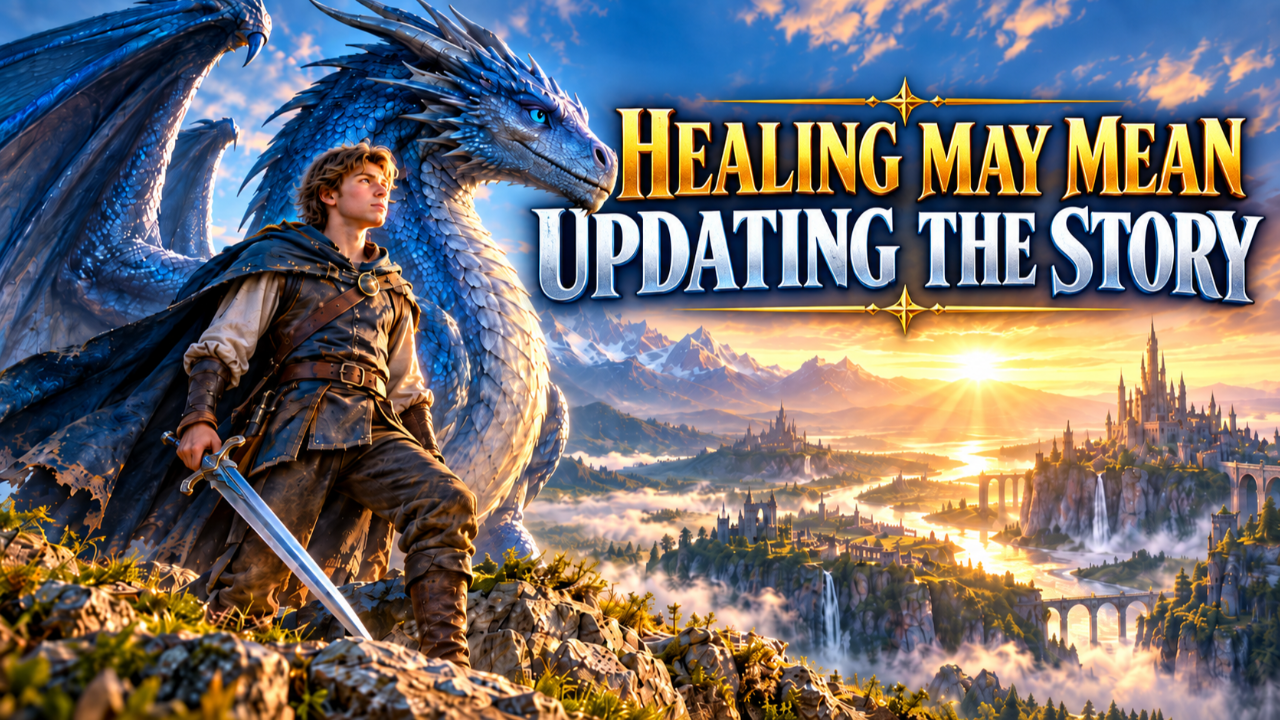
You Do Not Owe Your Struggle Permanent Residency...
I am reading the third book in the Eragon series right now, and I came across a passage that stopped me completely.
Eragon has finally accomplished something he has been pursuing since almost the beginning of the story. He has defeated the Ra’zac and avenged the destruction and losses connected to his old life in Carvahall. It is something he has carried for years. Something that gave his anger a direction and his grief somewhere to go.
You would expect the moment to feel entirely victorious.
Part of it does.
But there is sadness there too.
Because once the conflict is finally over, Eragon realizes that it was also one of the last threads connecting him to the person he had been before everything changed. The struggle itself had become a relationship with his past.
And then he has this realization:
“I refuse to become so attached to my struggle. . . that I won't want to move on to something else if and when the time comes, or worse, that I'll try to prolong the conflict rather than adapt to whatever happens next.”
Well...
That is an awfully profound thought to stumble across while reading a fantasy novel about dragons.
Because how often do human beings do exactly that?
How often do we become so accustomed to a struggle that eventually we no longer know where the struggle ends and we begin?
I see versions of this in my patients all the time.
Someone starts with back pain. At first, it is something that happened to them. “My back has been bothering me.”
Then six months pass. A year. Five years.
They learn how long they can sit before it hurts. Which chair they need. What movements they avoid. What side they sleep on. What activities are no longer worth attempting. Their family knows about it. Their coworkers know about it. Their doctors know about it. Their massage therapist, acupuncturist, chiropractor, or physical therapist certainly knows about it.
And slowly the language changes.
“I have a bad back.”
“I’m a terrible sleeper.”
“My knees are shot.”
“I can’t do that anymore.”
“This is just how my body is now.”
Something they were experiencing starts becoming something they are.
That is where I think healing becomes much more interesting than simply reducing a pain score.
Human Beings Adapt to Almost Anything
One of our greatest strengths is our ability to adapt.
If something hurts for long enough, you learn how to work around it. If your hip hurts, you change the way you walk. If your shoulder hurts overhead, you stop reaching that way. If you cannot sleep, eventually you learn how to function tired. If you are under enough stress for long enough, a certain level of tension starts feeling normal.
Thank goodness we can do this.
Adaptation is one of the reasons humans survive difficult things.
But adaptation has an interesting shadow side: what we adapt to can eventually become familiar enough that we stop questioning it.
The limp becomes normal. The poor sleep becomes normal. The tension becomes normal. The headaches become normal. The phrase “at my age” starts appearing with suspicious frequency.
Eventually, instead of asking, “Could this be different?” we begin designing our lives around the limitation.
That does not mean the pain is imaginary. It does not mean someone consciously chooses to remain injured, sick, or uncomfortable. Chronic pain is real. Injuries are real. Degeneration, neurological changes, illness, inflammation, scar tissue, structural damage, and nervous-system sensitization are real.
Mindset is not a magical eraser.
But identity matters too.
Because there is a difference between saying, “This is something my body is dealing with,” and deciding, “This is who I am now.”
I Am Having to Learn This in Real Time
This idea has landed differently for me because I am currently being forced to think about it personally.
Recently, I suddenly lost most of the hearing in my left ear. Along with that came severe vertigo and a disruption in my balance that, at least for now, has changed the way I move through the world.
I do not know yet exactly what recovery will look like.
That uncertainty is difficult because so many things I love depend on my body being able to orient itself confidently in space.
I climb.
I dance.
I bike.
I sail.
I travel.
I love scuba diving.
These are not little decorative hobbies sitting on the edges of my life. Movement, exploration, adventure, and physical capability are woven pretty deeply into how I experience being alive.
And now I have to consider possibilities I would rather not consider.
Maybe my hearing does not completely return. Maybe my balance takes much longer to recover than I want. Maybe there are activities I have to modify. Maybe there are things I eventually discover I cannot do in exactly the same way anymore.
I do not know.
And I am certainly not interested in pretending I know.
But reading that line from Eragon made me realize something very clearly: I refuse to become attached to this struggle.
I will treat it.
I will rehabilitate what I can.
I will rest when I need to rest. I will work with my doctors, acupuncturist, chiropractors, and massage therapists. I will experiment carefully with what my body can tolerate. I will be disappointed when disappointment is appropriate. I will probably get angry occasionally because being unable to bike straight when you very much enjoy biking is objectively irritating.
But I do not want “the woman who lost hearing in her left ear” to become my identity.
I do not want every future decision to begin with what happened to me.
And if there comes a point when something truly has changed permanently, I do not want to spend the rest of my life trying to prolong the fight against reality simply because letting go of the struggle would mean accepting that the next chapter looks different.
That does not mean surrendering early.
It means leaving room for whatever comes next.
There is a difference.
The Familiar Can Feel Safer Than the Unknown
I think this is one reason chronic problems can become psychologically complicated.
Familiar does not necessarily mean pleasant.
Sometimes familiar simply means known.
You know your back pain. You know when it appears. You know how to protect it. You know which activities to avoid. You know what to tell people. You know what your limitations are supposed to be.
There is certainty inside that story, even if it is a miserable story.
Healing introduces uncertainty.
Can I lift that again?
Can I travel?
Can I sleep without all the things I have built around my insomnia?
Can I trust this knee?
What if I try something and it hurts again?
What if I improve and then relapse?
What if people expect more from me once I am doing better?
And perhaps the strangest question of all:
Who am I if this is no longer my problem?
That does not mean someone wants to hurt.
It means humans build identity through repetition.
If you have spent ten years organizing your life around an injury, your body may improve faster than the rest of your life learns how to respond.
Your nervous system remembers.
Your habits remember.
Your language remembers.
Sometimes the story has to catch up too.
We Have Also Normalized Far Too Much Suffering
There is another layer to this that bothers me professionally.
Our culture has an incredibly casual relationship with physical decline.
“My knees hurt, but I’m getting older.”
“My back is always stiff now.”
“I haven't slept well in years.”
“Well, after forty…”
Apparently somewhere around middle age the human warranty expires and we are expected to quietly deteriorate while comparing prescriptions.
I do not buy that!
That does not mean I think aging changes nothing. Of course our bodies change. Recovery changes. Hormones change. Tissue changes. Muscle has to be maintained. Mobility requires attention. Injuries accumulate. Living years leave evidence.
But aging and suffering are not synonyms.
There is a tremendous difference between accepting that your body is changing and assuming that pain, weakness, immobility, exhaustion, and limitation are simply your new personality.
If everyone around you repeats, “That's just what happens at your age,” eventually it becomes very difficult to imagine anything else.
And before people can move toward something different, they usually have to believe that something different is possible.
That possibility may not mean returning to exactly who they were at twenty.
I actually think that is the wrong goal most of the time.
Maybe the goal is discovering what this body can become now.
Healing Requires Somewhere to Go
This is the part I find especially important.
If your entire goal is:
“I want my back pain gone,”
then back pain remains at the center of the story.
Everything is still oriented around the enemy.
I think eventually the question needs to become bigger.
What do you want back pain relief for?
Maybe you want to hike.
Garden.
Travel.
Play with your grandchildren.
Sleep through the night.
Get back on a bicycle.
Dance.
Golf.
Carry your own luggage through Europe without calculating the precise location of every bench between the train station and the hotel.
Now we are getting somewhere.
Because you are no longer simply fighting against pain.
You are moving toward life.
That is exactly what struck me about Eragon's realization. Defeating the enemy cannot become the entire purpose of his existence, because eventually the enemy may be gone.
Then he needs something worth living toward.
I think healing works the same way.
There comes a point when the question stops being only, “How do I make this hurt less?”
It becomes, “What do I want to do with the capacity I am getting back?”
That is a very different relationship with your body.
You Do Not Owe the Struggle Permanent Residency
I think this idea extends well beyond physical pain.
We can become attached to old conflicts, heartbreaks, betrayals, diagnoses, grievances, fears, and versions of ourselves that were built during difficult periods.
Sometimes those struggles were enormously important.
Honor that.
Maybe surviving them taught you resilience. Maybe they changed your priorities. Maybe they introduced you to people you would never have met otherwise. Maybe they forced you to become someone stronger, kinder, stranger, wiser, or more capable.
You do not have to minimize what happened in order to move beyond it.
But you also do not owe the struggle permanent residency.
There is a strange idea that letting go somehow diminishes the importance of what we went through.
I think the opposite may be true.
You can say:
That hurt. That changed me. That mattered.
And I do not live there anymore.
There is freedom in that.
Healing May Mean Updating the Story
If someone has spent ten years saying, “I have a bad back,” I am not suggesting they wake up tomorrow, stare dramatically into the mirror, and announce, “My spine is magnificent.”
Your nervous system would probably roll its eyes.
But perhaps the language can become slightly more open.
“I am learning what my back can tolerate now.”
“I am rebuilding strength.”
“I am figuring out what helps me sleep.”
“I am learning how to move with this body.”
“I am paying attention to what is changing.”
That language leaves room.
One identity says the story is finished.
The other remains curious.
And curiosity is incredibly useful in healing.
I am trying to use that same language with myself right now.
I do not know what my hearing or balance will be six months from now.
So I do not need to decide today what this means about the rest of my life.
Right now, I am someone recovering.
I am someone learning how my body responds.
I am someone finding out what is possible.
That is enough.
And if what is possible ends up looking different from what I originally imagined, then I will have another decision to make:
Fight reality forever because it is not the version I wanted?
Or adapt and ask what adventure comes next?
I know which person I want to be.
What If You Got Better?
So here is the question I want to leave you with:
What would actually change in your life if this struggle improved?
Not simply what would your pain score be.
What would you do?
Where would you go?
What would you try?
What would you stop avoiding?
How would you describe yourself differently?
Would you have to revise something you have believed about yourself for years?
And perhaps there is an even deeper question beneath that one:
Have you left enough room in your identity to become someone who no longer has this problem?
You do not have to force an answer.
You do not have to pretend your pain is gone when it is not.
You do not have to think positively until reality becomes inconvenient.
Treat what still needs treating.
Rehabilitate what can be rehabilitated.
Ask for help.
Respect the body you actually have.
But remain open.
Because maybe healing is not only about reducing symptoms.
Maybe part of healing is refusing to become so attached to the struggle that, when life finally offers you something beyond it, you no longer know how to leave.
I do not want that for my patients.
And right now, I do not want it for myself.
Whatever happens with my hearing, balance, climbing, dancing, sailing, diving, or anything else from here, I want to remain curious enough to meet the person on the other side of this.
Maybe she gets everything back.
Maybe she adapts.
Maybe she finds something she has not even thought of yet.
That is the part I refuse to close off.
You are allowed to honor what you survived without making it the rest of your identity.
You are allowed to recover.
You are allowed to adapt.
You are allowed to become interested in something beyond the fight.
And when the time comes, you are allowed to move on.
Keep moving, eat something green, and question anything that sounds like a quick fix.
Chow! Chow!