Your Life Needs a Training Plan
Sep 29, 2026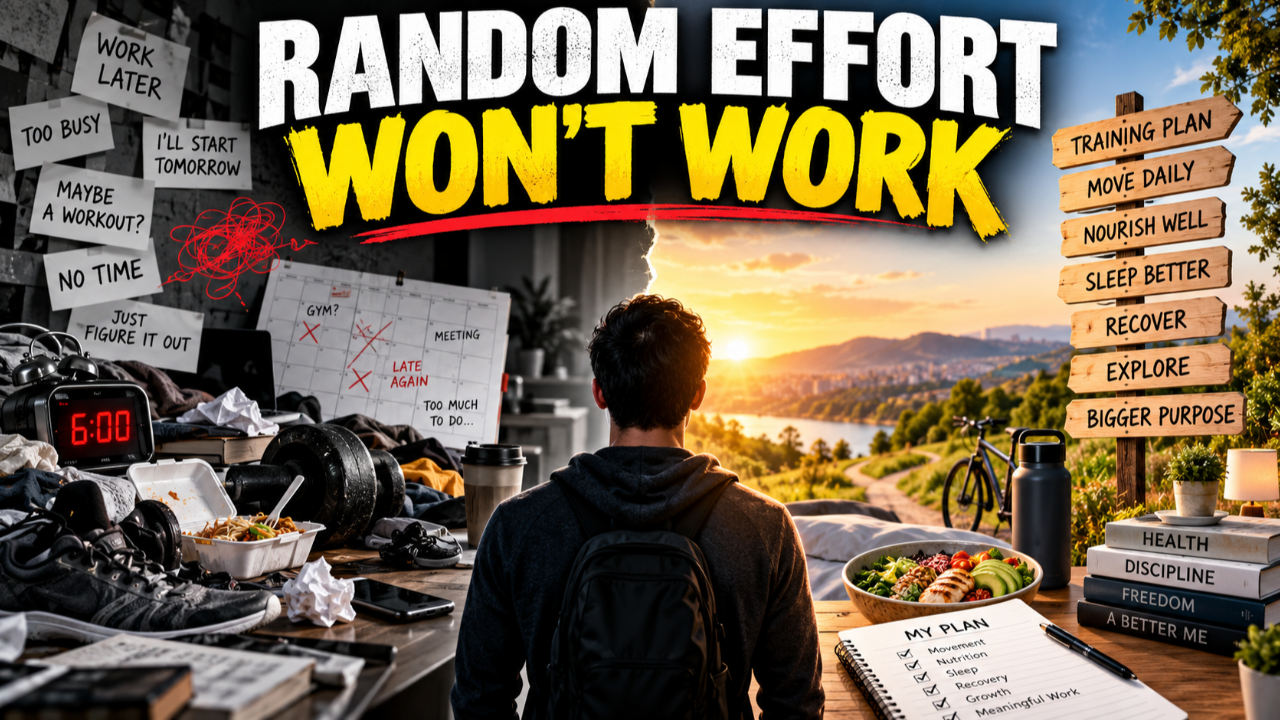
You would never train for a season with random effort.
You would not sign up for a marathon, jog once every three weeks, think vaguely about stretching, buy some new shoes, and then arrive at the starting line genuinely offended that your body was not prepared. You would expect there to be some kind of plan: training days, recovery days, progression, nutrition, sleep, practice, repetition, a goal, and a date on the calendar when all that effort is supposed to mean something.
And yet this is exactly how many people approach their health as adults. We move when we have time, sleep when we are exhausted, eat well when we feel motivated, rest when we finally collapse, and think about stress management while actively answering an email we should not be answering at 10:47 p.m. Then we look at our bodies somewhere around forty and say, “What happened?”
Well. You have been training for something. The question is whether it is the thing you actually wanted.
If your days are built around sitting, rushing, poor sleep, convenience food, constant stress, and putting yourself last, your body is adapting to that environment. Bodies are extremely cooperative that way. You train them every day, not just in the gym. That is why I think more adults need to stop thinking of health as something they are supposed to “get around to” and start thinking about their lives the same way an athlete thinks about a season.
Your life needs a training plan.
Not because your entire existence needs to become some miserable optimization project. Please do not create an Excel spreadsheet for joy. I mean that your life deserves enough intention that the things you claim matter to you actually have a chance of happening.
What are you training for?
When I was younger, this question was easy. I played volleyball. We trained to win. There was a game coming, then another game, then a tournament, then a season. The goal was tangible, the feedback was immediate, and nobody had to explain why we were practicing. If we wanted to perform well on Saturday, what we did on Monday mattered.
Adult life is stranger. The goals get bigger, but the deadlines get fuzzier.
Maybe now you are training to still hike when you are seventy. Maybe you want to travel without your knees, back, digestion, or energy level turning every trip into a negotiation. Maybe you want to be able to get down on the floor with your grandchildren one day and, more importantly, get back up without needing a small rescue team. Maybe you want to continue skiing, climbing, gardening, sailing, dancing, biking, playing golf, or wandering through foreign cities for twelve miles because you saw an interesting church three neighborhoods away and decided, naturally, that you needed to investigate.
Maybe you simply want to age with a body that remains useful to you: strong legs, good balance, a capable heart and lungs, enough muscle and mobility to remain independent, a nervous system that knows how to come back down after stress, a relationship with food that supports you instead of exhausting you, a mind curious enough to keep learning, people, purpose, adventure. Whatever matters to you.
Those are training goals too.
But because there is no championship game next Saturday, we treat them as vague hopes. “I want to be healthy when I’m older.” Wonderful. What are you doing on Tuesday?
That is where the idea gets interesting. A goal like age gracefully sounds lovely, but it is almost useless until you translate it into what that requires from you now. If you want to remain strong later, you need to use your muscles now. If you want to travel easily later, you probably need some endurance, mobility, financial planning, curiosity, and the willingness to keep leaving your comfort zone now. If you want meaningful relationships later, you cannot postpone every dinner, phone call, friendship, and community until your work finally becomes less busy. If you want to remain mentally alive, you need to keep reading, learning, questioning, trying things, and occasionally being terrible at something new.
The future version of you is being trained by present-you. Every day.
Consistency outranks intensity
This is one of the ideas I teach constantly. You do not need to become ten percent better tomorrow. You need one percent, and then another one percent. A walk. One better meal. Ten minutes of mobility. Going to bed a little earlier. Picking up the book. Making the phone call. Going to the climbing gym even though you only have forty minutes. Booking the trip instead of saying, “Someday.”
Consistency will outrank intensity almost every time because intensity is easy to romanticize. Intensity feels impressive. We love the dramatic beginning: the detox, the six-day workout plan, the new notebook, the declaration, the transformation photo. Consistency is much less glamorous. Consistency looks like eating your vegetables again on a completely ordinary Wednesday. Nobody applauds. There is no soundtrack. But that is where most lives are built.
Here is the problem, though: one percent improvement only matters if you know what direction you are moving.
You can walk one percent farther every day, but if you are heading toward Cleveland and wanted to go to California, congratulations on your excellent consistency.
Direction matters.
“What you focus on grows” sounds almost painfully simple, but I think there is enormous truth in it. Attention changes behavior. Behavior compounds. Eventually, the things we repeatedly give our time to start taking over the landscape of our lives.
Which means your goals need to be more meaningful than “lose ten pounds.” Why? For what? What does losing ten pounds allow you to do? What does being stronger give you access to? What does having more energy make possible? What kind of life are you trying to create with the body you are caring for?
I am far more interested in that question, because the scale is a terrible reason to get out of bed for the next thirty years. A life you are excited to participate in? That might work.
Life without deadlines gets weird
There is an idea I learned when I was younger that has stayed with me: work tends to expand into the time we give it. Give yourself three weeks for a project and somehow the project takes three weeks. Give yourself until Friday and suddenly Thursday becomes extremely productive.
We understand this intuitively because school and work are full of deadlines. The professor tells you when the paper is due. The boss tells you when the presentation needs to be finished. The coach tells you when the game starts. And because there is a deadline, things happen.
Then adulthood arrives and some of the most important things in life suddenly have no due date. Read more. Learn another language. Get stronger. Write the book. Travel. Learn to sail. Play an instrument. Repair the relationship. Make friends. Spend more time outside. Develop a spiritual practice. Become someone interesting.
There is no professor standing there saying, “Your curiosity project is due November 14.”
So we keep postponing it. After this busy season. After the kids are older. After the promotion. After the move. After we save more money. After things calm down.
Which is adorable because apparently we all believe there is a quiet little meadow somewhere in adulthood where nothing needs our attention.
I have not found it. If you do, send coordinates.
This is where I think we need to create some of our own deadlines. Not terrifying ones. Alive ones. A hiking trip next summer. A 5K in May. Dance lessons this winter. The sailing course you keep talking about. A book you want to finish this month. A trip you actually put on the calendar instead of saving fifty Instagram posts about it. A strength goal. A climbing route. A garden. A class. Something that gives your daily effort a destination.
Because without some kind of destination, even very capable people drift.
Then there is the final deadline
I do not mean this morbidly. I mean it realistically.
We all eventually get one final deadline. And unlike the biology paper you started the night before it was due, this is not the sort of project you want to discover at the last minute that you forgot to actually live.
I have met enough people, treated enough patients, traveled enough, and watched enough lives unfold to know that the things people ache for later are rarely more emails. They want time. Strength. People. Experiences. Freedom. They want to travel. They want to feel good enough to go somewhere. They want to repair something they let sit too long. They want to do the thing they kept saying they would do when life slowed down.
That does not scare me. It motivates me.
I love being alive. I want to use the whole thing.
I want to keep learning and moving and traveling and reading and climbing and dancing and sailing and meeting strange people in strange places and asking questions that make dinner conversations last too long. I want to be better at eighty than I am now at some things.
Probably not volleyball. Let us remain reasonable.
But wiser? More curious? More skilled? More interesting? More capable of enjoying the world? Absolutely.
That is what I am training for.
I do not want to reach the final deadline frantically trying to cram for my own life like I remembered the biology paper at breakfast and it is due at midnight. I want the paper written. With edits. Possibly illustrations. And plenty of extremely unnecessary footnotes from places I went because I was curious.
A training plan needs recovery too
There is one important difference between a training plan and a punishment plan: a good training plan respects adaptation.
Athletes do not become stronger during the workout. The workout creates a stimulus. The body then needs recovery to adapt to it. Life works the same way. Effort and recovery. Challenge and rest. Expansion and integration.
Training harder forever is not a plan. It is eventually an injury.
That applies far beyond exercise. You cannot run a nervous system at maximum output forever and call yourself productive. You cannot sleep five hours, live on adrenaline, eat standing up, ignore every emotional signal, and then solve the problem with magnesium.
I like magnesium.
It is not that talented.
Your life plan needs room for restoration. It needs people who make you feel more like yourself. It needs food that supports you, movement, sleep, play, silence, and days where the objective is not productivity.
It also needs seasons. Some seasons are expansion. Some are maintenance. Some are rebuilding. Some are grief. Some are adventure. Some are winter.
A mature training plan adjusts.
So should you.
Train for the life, not the metric
This is where I think our health goals become much more interesting. Instead of asking how much you should weigh, ask what you want your body to be capable of. Instead of asking how many workouts you should do, ask what kind of movement supports the life you want. Instead of searching for the perfect diet, ask how you want food to make you feel and what way of eating you can realistically repeat.
And instead of asking how to become more disciplined, ask: What deserves enough importance in my life that I am willing to structure my time around it?
That might be the big one.
Because we somehow find time for what has consequences. We finish the assignment. We attend the meeting. We make the flight. We show up for the game.
The challenge of adulthood is learning to create enough importance around the things that do not come with externally imposed deadlines: your health, your relationships, your curiosity, your strength, your experiences, your joy, your development as a human being.
Nobody is going to stand over you and make sure you live an interesting life.
That responsibility eventually becomes yours.
And I actually think that is wonderful.
It means you get to decide what you are training for.
Maybe your next season is about strength. Maybe it is about getting your energy back. Maybe it is about sleep. Maybe your training goal is rebuilding a social life after years of work swallowing everything. Maybe it is finally taking the trip. Maybe it is being strong enough to climb a mountain. Maybe it is being healthy enough to play with grandchildren who do not exist yet.
That might sound fantastical.
Good.
A goal should pull something out of you. There is nothing wrong with having a vision far enough ahead that you have to grow toward it.
So, what are you training for?
Not just this week. Not for your next weigh-in. Not for January.
Your life.
When you picture yourself ten, twenty, thirty years from now, what do you still want to be doing? Where do you want to go? Who do you want beside you? What kind of body do you need to participate in that life? What skills will you need? What relationships need tending? What part of yourself needs one percent more attention now?
Then work backward.
That is a training plan.
Not a perfect schedule, a punishment, or a rigid set of rules. It is a direction, a few meaningful goals, daily and weekly actions that support them, enough recovery to keep going, enough flexibility to change when life changes, and enough consistency that eventually those tiny choices become a life.
You would never train for a season with random effort. Why are you trying to build your health that way?
Know what you are training for. Then give it one percent today.
And tomorrow, if you are lucky enough to get another day, train again.
Keep moving, eat something green, and question anything that sounds like a quick fix.
Chow! Chow!