Stop Trying to Be Your Own Drill Sergeant
Sep 22, 2026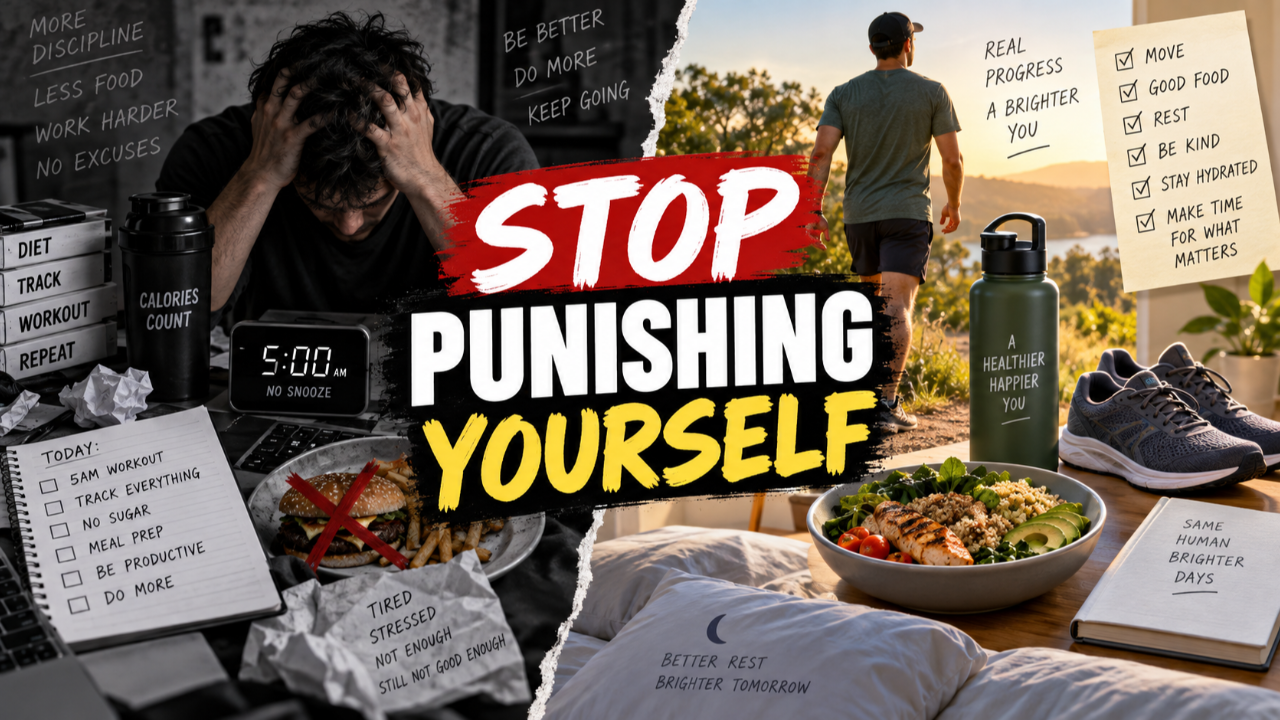
It usually starts on a Sunday night.
You have had enough. Enough eating whatever was easiest. Enough skipping workouts. Enough staying up too late. Enough feeling tired, stiff, sluggish, scattered, or generally less like the person you know you could be.
So you decide: That’s it. Monday I’m getting back on track.
You download the app. You clean out the refrigerator. You buy enough vegetables to suggest you are preparing for a minor agricultural emergency. You decide you are going to work out five days this week. Maybe six. You will walk every morning, strength train, stretch, meal prep, drink three liters of water, stop drinking alcohol, stop eating sugar, stop ordering takeout, go to bed by ten, wake up early, take your supplements, get ten thousand steps, and perhaps begin journaling because apparently this new version of you also has feelings and excellent handwriting.
Monday goes pretty well. Tuesday is still respectable. Wednesday gets complicated. By Thursday, you work late, sleep badly, forget lunch, miss the workout, eat something you had recently declared forbidden, and suddenly the whole operation feels compromised.
By Friday, you are standing in the kitchen eating directly out of a container thinking, “Why can't I stick with this?”
And somewhere in your head, the drill sergeant appears.
You need more discipline. You are making excuses. You used to be tougher than this. Get it together. Start again Monday.
This is one of the strangest things capable people do when their health starts slipping: we respond to a life that has become difficult to manage by making the rules even harder.
We assume the problem must be discipline, so we prescribe ourselves more discipline. More restrictions. More expectations. More tracking. More pressure. And when that plan eventually collides with actual life, we take the failure personally instead of considering the possibility that the plan itself was badly designed.
I think former athletes are particularly vulnerable to this.
We know how to push. We know how to endure discomfort. We know how to perform under pressure. We know what it feels like when a coach says, “One more,” and somehow you find one more.
There was a time in my own life when three-a-day volleyball practices, workouts, classes, games, travel, and competition were normal. I had coaches telling me what to do, teammates doing it beside me, and a season giving all that effort a purpose. Sometimes pushing through exhaustion made sense because there was an actual game we were preparing to win.
That structure belonged to that version of my life.
I am not a college volleyball player anymore. And thank God, because I am fairly certain my forty-something-year-old body would file a formal complaint if I tried to schedule three-a-days now.
Yet I think many of us unconsciously try to recreate that mentality when we decide it is time to “get healthy again.” We remember that discipline worked, so we become our own coach. Unfortunately, the only coaching style we seem to remember is the one yelling from the sideline.
But adult life is not preseason training camp.
Your body is different. Your responsibilities are different. Your stress is different. Your recovery needs are different. And perhaps most importantly, the reason you want to be healthy is different.
At twenty, maybe you were training to win the game. At forty, maybe you want enough energy to hike on Saturday, stay sharp at work, sleep well, have good sex, travel without feeling wrecked, climb, bike, play with your kids, recover from stress, and still be doing interesting things when you are seventy.
That goal requires discipline, certainly.
But it requires wisdom even more.
The answer is not more punishment. The answer is better design.
This is where a lot of modern wellness advice gets ridiculous. We love plans that look spectacular on paper: the perfect morning routine, the thirty-day challenge, the twelve-week transformation, the flawless meal plan, the workout schedule that apparently assumes your job, family, commute, relationships, laundry, fatigue, and basic human unpredictability have all agreed to stop interfering.
Those plans are usually built for fantasy-you.
Fantasy-you wakes up rested every morning. Fantasy-you meal preps on Sunday with the enthusiasm of a cooking-show contestant. Fantasy-you never works late, never gets sick, never travels unexpectedly, never has a bad night's sleep, and has absolutely no desire to eat something delicious simply because it is delicious.
Fantasy-you is exhausting.
More importantly, fantasy-you does not have to live your life.
You do.
Actual-you might have a stressful job. Actual-you might have children, aging parents, irregular hours, relationships, travel, fluctuating energy, or a body that requires more recovery than it did at twenty-two. Actual-you might occasionally want dinner with friends instead of steamed broccoli consumed in solemn obedience to a macro calculator.
Actual-you is not the flaw in the plan.
Actual-you should be the person the plan was designed for.
That sounds obvious, yet most of us do the opposite. We create an idealized health plan first and then try to force our real lives inside it. When they do not fit, we blame ourselves.
I think it is far more useful to reverse the process.
Look at the life first.
Then design the health structure.
I learned this with exercise. For years, I thought I should enjoy working out alone in a gym. I know how to do it. The gym certainly is not foreign to me. I understand the value of strength training. But if that were the only form of movement I allowed myself, I would spend a ridiculous amount of energy fighting my own personality.
I would much rather climb. Dance. Hike. Walk. Bike. Give me movement with a skill, a destination, an adventure, a social component, or something interesting attached to it and suddenly consistency becomes much easier.
So instead of continuing to ask, “Why can’t I make myself love this workout?” I started asking, “What kind of movement will I actually want to return to?”
That is not a softer question.
It is a smarter one.
The same applies to food. If your healthy eating plan requires ninety minutes of cooking every evening and you routinely get home exhausted at seven, you may not have a discipline problem. You may have a ridiculous dinner plan.
Maybe you need five meals you can make almost without thinking. Maybe frozen vegetables belong in your freezer. Maybe overnight oats should already be waiting in the refrigerator. Maybe you need better snacks available before hunger turns you into a raccoon rummaging through the kitchen for anything technically edible.
Healthy design reduces unnecessary friction.
Want to walk in the morning? Put your shoes where you see them. Want to drink more water? Keep the bottle beside you. Want to eat more vegetables? Buy ones you actually like. Want to get to bed earlier? Stop constructing an evening that requires fourteen remaining tasks at 9:57 p.m.
This is not cheating.
This is intelligence.
Somewhere along the way we absorbed the idea that healthy choices only count when they are sufficiently inconvenient. If it was enjoyable, easy, social, or pleasurable, apparently we did not suffer enough for it to qualify as wellness.
Nonsense.
Think about what you would actually expect from a good coach. A competent coach does not demand maximum output every day regardless of circumstances. If an athlete slept four hours, is limping from yesterday's workout, and is showing signs of poor recovery, a good coach does not scream, “Sounds like weakness. Double the sprints.”
That would not be discipline.
That would be stupidity.
A good coach observes. A good coach knows when to push and when to recover. They understand progression and adaptation. They know there are hard training days, lighter days, maintenance periods, recovery periods, and entire seasons with different objectives.
Why would your adult health deserve anything less intelligent?
Yet many people coach themselves more harshly than they would tolerate from anyone else. A low-energy day becomes laziness. A missed workout becomes failure. Dessert means they have “fallen off.” A difficult week becomes evidence that they simply do not have what it takes.
Then comes the punishment: harder workout tomorrow, less food, more restriction, more guilt.
That is not coaching.
That is harassment.
And it is also where we need to distinguish consistency from rigidity.
Consistency means you keep returning to the behaviors that support you. Rigidity means those behaviors are only allowed to happen one specific way.
If you normally take a forty-five-minute walk but a chaotic day only gives you ten, consistency says, “Ten minutes it is.” Rigidity says, “It does not count.”
If you usually cook a beautiful dinner but tonight you have enough energy for soup, vegetables, toast, and fruit, consistency recognizes that you still fed yourself reasonably well. Rigidity turns dinner into a moral crisis.
If your full strength workout is not happening today but you can do ten minutes of mobility and a few exercises, you did not “fall off.” You adapted.
That ability to adapt may be one of the most important health skills you can develop.
One practical way to do this is to create an ideal version and a minimum version of the habits that matter to you. Maybe the ideal workout is forty-five minutes, while the minimum is ten. Maybe the ideal evening involves tea, stretching, reading, and lights out at ten, while the minimum is simply putting the phone down half an hour earlier.
The minimum is not there because you expect little from yourself.
It is there because life will not always cooperate with your ideal.
Your health needs a backup plan.
This is why I keep returning to the idea of small improvements. Not because tiny goals are adorable, but because small behaviors survive. They survive stressful Tuesdays, travel, deadlines, bad moods, and weeks when the universe appears to have added extra meetings purely for sport.
And what survives can become consistent.
This is also where your inner coaching voice matters.
A drill sergeant asks, “Why aren't you doing more?”
A wise coach asks, “What is getting in the way?”
A drill sergeant assumes something is wrong with you.
A wise coach asks whether the plan was realistic.
A drill sergeant always prescribes more effort.
A wise coach considers whether you need effort, recovery, support, or a different strategy entirely.
I am not suggesting you become so endlessly compassionate with yourself that every preference becomes an excuse. There will absolutely be days when the answer is, “I do not feel like doing this, and I am doing it anyway.”
That is discipline.
But there will also be days when the honest answer is, “This system keeps failing because it does not fit my life.”
That is when discipline means changing the design instead of repeating the punishment.
Compassion without responsibility can become avoidance.
Responsibility without compassion becomes punishment.
We need both.
And ultimately, I think there is a much better measure for whether a health plan is working than how impressive it looks on paper:
Does it give you more life?
Does it give you more energy, strength, mobility, confidence, adventure, connection, and ability to participate in the things that actually matter to you?
Or does it mostly give you more rules?
Because you can create an extraordinarily disciplined life that is also miserable. You can count everything, track everything, optimize everything, avoid everything, and control everything until you become so consumed with being healthy that you barely have time to enjoy being alive.
That is not what I want.
Health should support the life.
The life should not become a full-time support system for the health plan.
That idea is becoming increasingly central to my work, both in Building Healthy Habits and in the coaching work I am developing now. I am not interested in handing someone my routine and telling them to copy it. My routine works because it belongs to my life.
Yours needs to belong to yours.
And it will need to change.
The structure that works when you are thirty may not work at forty. The routine that works when you are single may change when you have children. Summer and winter may require different rhythms. Work changes. Bodies change. Interests change. Priorities change.
None of that means the plan failed.
It means you are alive.
The goal is not to discover the perfect health routine and cling to it forever. The goal is to understand yourself well enough that you know how to adjust when your life changes.
So the next time you hear yourself declaring, “That’s it. Monday I’m getting serious,” notice what happens next.
Before you invent seventeen new rules, ask yourself what is actually not working. Is the healthy choice harder than it needs to be? What could make it easier to repeat? What version could you maintain during a difficult week? Are you designing this around your actual life, or around fantasy-you?
And most importantly: is this helping you build a life you actually want to live?
The answer is not more punishment. The answer is better design.
Keep moving, eat something green, and question anything that sounds like a quick fix.
Chow! Chow!